Episode 465 - The Roadless Rule
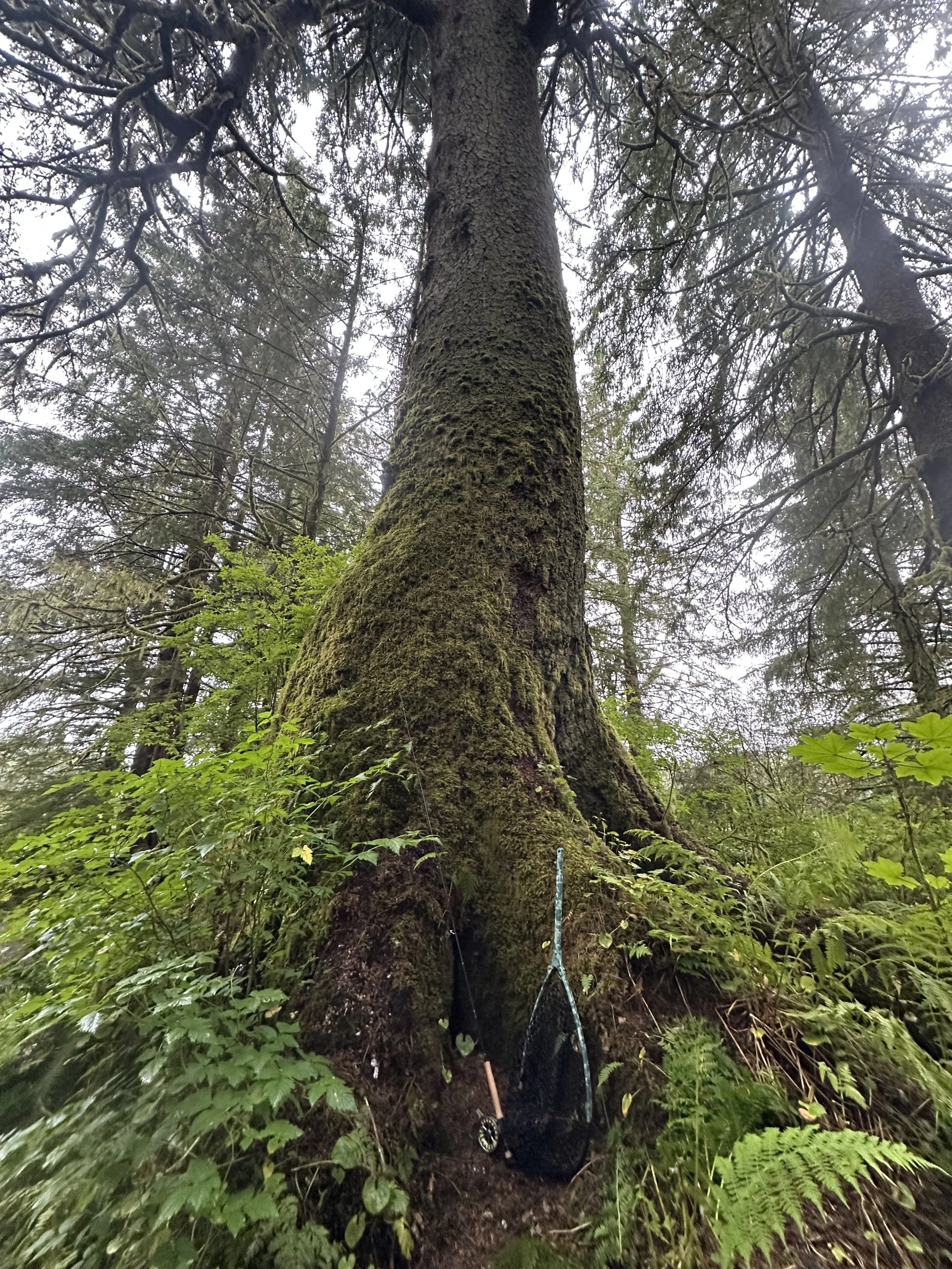
Trout Unlimited CEO Chris Wood discusses the history and impact of the Roadless Rule, the Tongass National Forest, and how roads and logging affect salmon habitat in Southeast Alaska. We talk about the rule’s origins, lessons learned over 25 years, the need for balanced local economies and recreation, and how collaborative restoration and thoughtful management can protect fish, communities, and sustainable timber uses.
On Step Alaska — Interview with Chris Wood, CEO of Trout Unlimited
On Step Alaska: Chris, welcome to the podcast. Thanks for being on here.
Wood: Hey Jeff, it's great to be with you.
On Step Alaska: So you have some background with the roadless rule. Were you part of the actual writing of it?
Wood: I was, yes. I worked for a man by the name of Mike Dombeck, who was the Chief of the Forest Service from 1997 to 2001. And this was one of our seminal accomplishments — protecting 58 and a half million acres of these so-called roadless areas across the National Forest System.
On Step Alaska: I'm more familiar with the Tongass portion of that. So we've got a couple of dates here. The Tongass National Forest was created in 1907. There was a 50-year contract to log a portion of it that was awarded in 1947. So in those 50 years until 1997, a tremendous amount of logging was done — over a million acres of Tongass old growth was logged during that time. And if you go back 100 years, almost half of the 5 million acres of old growth have been logged. The roadless rule was initiated, passed, went into effect in 2001, and then was reinstated in 2023. So what was the attitude, the temperature around conservation back when the rule was being written? How was the reception?
Wood: It's such a good question, Jeff. The way the roadless rule really initiated was that the Forest Service was carrying about an $8.6 billion — with a B — maintenance backlog on its existing road system. And the House of Representatives and the Senate came within a single vote of eliminating 80% of the Forest Service road budget, including road maintenance and reconstruction. They were doing that as a surrogate to try to get the agency to stop building roads into these so-called roadless areas.
And in Alaska, you did a really good job of summarizing the 50-year timber contract that expired and really left people scratching their heads wondering what's next. What we did initially at the Forest Service, before the roadless rule existed, was we created a rulemaking that would allow us to basically get a handle on how to take care of the existing road system. So very few people know that before the roadless rule, we actually did a roads rule. And part of that roads rule was to put a moratorium on all new road construction anywhere on the national forest system — including in heavily logged and roaded areas — for 18 months.
Once we did that, people made very, very clear that these are lands owned by the American people. And the American people made clear in no uncertain terms that the values they cared about from these public lands, and especially these roadless areas, were the sense of naturalness, the wildness, and the recreation opportunities. Oh, and yes, they're important for commodities, but only to the extent that the development of those commodities doesn't harm the ecological sustainability of the system. And it was that sort of aha moment that led us to look at roadless areas on their own merit.
Another fact a lot of people have forgotten is that the draft rule that came out in 2000 didn't actually include the Tongass or the Chugach. And here you're talking about 17 million acres. It's the Tongass that was most important, both from a fisheries perspective and because Southeast Alaska was the area that had been hit hardest by the logging you mentioned. And so it was in response to those public comments that we said, okay, in the final rule, the Tongass will be included. Why wouldn't we act to protect the best of what remains before it's lost?
If you look at the value of those Tongass roadless areas, it's about 9 million of the 16 or 17 million acres on the Tongass that are roadless. But more than 70% of all the Southeast Alaska Chinook, coho, and chum populations come from roadless areas. It's in the mid-80s — 80, 85% or more of all Southeast sockeye populations come from roadless. These lands are just incredibly important from a fisheries perspective, because roads have a tendency, especially in rugged climates, to change things. Gravity works cheap and it never takes a day off. You build a road on a hillside and it's eventually going to want to fall into the creek down below it. And that's what happened with a lot of those roads that were connected to the Louisiana-Pacific contract you mentioned.
On Step Alaska: I remember I was in middle school when some of my buddies had to move away. I grew up on Prince of Wales Island — not necessarily the epicenter, but definitely kind of an epicenter for the contention. Living in a logging community, even though Klawock was predominantly Native, there was this idea that logging was just done. Some people had moved from Oregon as loggers because of the spotted owl issue. So there was this anti-conservation feeling — I mean, I'm thinking back to my middle school and high school days when I wasn't really paying attention, mostly focusing on sports and girls.
Wood: You got started faster than me if you were looking at girls.
On Step Alaska: So it wasn't really this conservation-habitat type conversation. It was just more of a — well, logging was done — and you looked around the island and thought, yeah, there's not a whole lot more that could be logged. Because in addition to logging on Forest Service land, village corporations were logging and regional corporations were logging. Even though Southeast Alaska is mostly made up of Tongass, there was a lot of state land and private corporation land also being logged. And it did look like yeah, there wasn't a whole lot left. Some of the old stands were pretty hard to get to. All the easy stuff had been taken out. There was some stuff that had been learned in the 70s and 80s about the importance of buffer strips. Can you talk a little bit about that? Because on some of the private land logging, there wasn't much of a buffer at all. I remember driving across some of those rivers and it just looked like a dead river — nothing left in there.
And to go back even further, you had the initial insults where canneries would set up their entire facility at the mouth of rivers in the 1880s and 1890s. Klawock had the first salmon cannery in Alaska. They would set fish traps and nets almost all the way across the mouth of the river. There was some repeal of that in 1924, and then you had the logging on top of it. So you went after the fish themselves and then the habitat — it's pretty amazing there's as much left as there is.
Wood: Yeah, it's true. And I always have to remind myself when we talk about the canneries and some of the logging practices back in the day — we didn't know we were doing anything wrong. People thought salmon were a resource that could never be exhausted. If you want to really depress yourself someday, go to Monterey, California. They have a museum there in that wonderful aquarium that talks about the fall of the sardine fishery. This was a fishery where you could walk out into the surf with a ball cap and scoop up sardines. And now they're gone. We just thought they were inexhaustible.
And you think about America at that time — the frontier was limitless. You could keep moving west. There were all these incredible old-growth forests, these magnificent rivers. We can harvest the wood fiber, build homes, build roads, build dams and create electricity. All of it was well-intentioned. It was all designed to make people's lives better. We didn't know the effects we were having on the environment. And we do now.
That's why I know Alaska salmon runs have been in a difficult place the past couple of years. But I do respect Alaska Fish and Game's management of those resources. They've really realized that these are not inexhaustible resources. It's why we fought so hard to protect Bristol Bay. In the lower 48, we've spent something like $12 to $13 billion trying to recover Pacific salmon in the Snake River Basin. And you've got a place in Bristol Bay — which is in southwest Alaska — and I fish up there every year. It's just like God made it. It's intact.
I remember the first time I went there, I had just heard about this so-called Pebble Mine about 17 years ago. I was training for a marathon at the time and I thought, well, I brought my running clothes and I'll run every day. There's no road.
On Step Alaska: That's hilarious.
Wood: A flatlander from New Jersey. Didn't know any better. And all we have to do to keep that system intact is just have the wisdom to leave it alone. To have the humility to say that some places should just be left as God created them. And that's what makes Southeast Alaska so important. Yeah, we really whacked it — Prince of Wales was one of the places we whacked pretty hard back in the day. But those forests produce incredibly abundant runs. Forty percent of the salmon that swim along the West Coast are coming from the Tongass.
So to go back to your initial question — we started out looking at, well, how does it make sense to build more roads when you can't afford to take care of the road network you already have? So we did that 18-month moratorium. And in doing that, we realized that was the right thing to do. It's actually a conservative management principle — the height of conservatism is not to make new investments until you can take care of the investments you've already made. But in the context of asking people about that, we learned that what they really cared about were these wild lands, these roadless areas, where all these salmon and steelhead and hunting opportunities persist today. That's why we made the pivot to focus on roadless. And yes, I was very much an advocate for that then and I am today, because the fact is we've got plenty of wood fiber in Alaska. You don't need to pump roads into these backcountry roadless areas and have the attendant impacts on big game hunting, recreational opportunities, and the basic sustenance for many indigenous communities who live off these resources.
I think about Igiugig and some of these other Native villages in the Bristol Bay region. They're not like me, some gringo coming in for four or five days having the fishing of my life and then leaving with a bunch of memories. They live off those resources. Those subsistence fisheries are real. And it just seems to me that a conservative approach to managing those backcountry areas is in the best interest of the nation.
On Step Alaska: Yeah, one of the things people also got upset about with the Forest Service — you had all of these logging roads, but the alders take over so quickly. And then the Forest Service would dig out the culverts because inevitably the culverts would get blocked and you'd have either a lack of passage for fish for spawning, or it would build up against the road and cause a slide and just deteriorate. And there wasn't the budget to keep the roads maintained. When people say, hey, why are you water-barring these roads? Because at least it's access for us to get to rivers or hunting grounds. Well, there's just not enough money to maintain both.
Another thing about the conversation in general that I don't remember from before — I don't know if it was there — is the idea that a conservation group is not anti-mining, it's not anti-logging, it's just anti the wrong type of stuff. I don't know if that was part of the conversation in the 90s and early 2000s. Do you remember that? Or is that some nuance that has become part of the messaging now so that conservation organizations don't end up sounding like radical activists — no logging whatsoever, no mining whatsoever? So can you compare and contrast the attitude, the nuance, and the messaging?
Wood: Yeah, totally. There are two points you raised. One is that creek-edge to creek-edge logging that used to occur. Particularly in places like Prince of Wales Island, there were small buffer strips on forest plans even back when you were a kid, but they were small. And what we realized is that fish — coho, all salmon really, and steelhead and trout — they need that wood to fall into the creek to provide shelter and cover, to slow the energy of the creek, and slow sedimentation from the hillslopes. When you cut edge to edge, like was happening on a lot of private lands and to some extent on Forest Service lands because the buffers were so small, we lost all that habitat. When you lose the habitat, you lose the fish. It's not any more complicated than that. The trees will grow back over time, but whether the runs come back or not is a different question.
We did a lot of work back in the day in places like Staney Creek and the Cube Cove area. The Forest Service did a major restoration near Sitka — I can't remember the specific area at the moment — but they had heavily logged and roaded it between 1968 and 1974, and there was so little habitat and so little woody debris falling into the creeks that the streams basically became ditches. And it was the first time, I believe, that the state of Alaska ever closed fishing in Southeast Alaska to salmon fishing. Then the Forest Service did a major restoration in the 90s, which helped replace a lot of those culverts that were built in the 60s and 70s. They were wooden — think about how long a wooden culvert is going to last in Southeast Alaska. So they went in and replaced those. We did a lot of good work with the Forest Service.
And to answer your threshold question — we know so much more today. Back in the 70s and 80s, the Forest Service used to call the trees they would leave up along the creeks "beauty strips." That was so the cruise ships wouldn't see these denuded landscapes as they floated by. But now we realize we need to leave three, four, or five hundred feet from the edge of the stream so that wood can make its way in and provide that habitat complexity in those pools, that cover habitat, and help those streams have their natural sinuosity — their bendiness. Every fly angler, every spin angler, every bait angler knows that you fish the bend in the river, because there's going to be a pool there and probably a big fish holding under it.
So that speaks to that point. But to your point about reasonable development — the Forest Service is a fundamentally different agency than it was when I was there 24 years ago. Between 1960 and 1990, the Forest Service annually harvested about 9 to 12 billion board feet of timber off the national forest system every year. Today they harvest about three billion. And that decline came about largely because of litigation in the Pacific Northwest over the Spotted Owl. So the agency was in this period of transition when Mike Dombeck and I and others arrived in 1997. They were struggling to figure out what the role of the Forest Service was. Part of the intent of the roadless rule was to reassert the Forest Service's conservation leadership in the country. I think it was effective at doing that.
The Forest Service today has some of the strongest advocates for conservation and restoration in the country. And I can tell you with almost moral certainty that this current rulemaking to undo the roadless rule is something the agency itself would not do if they were not being told to do it.
Because the point you made a moment ago is exactly right. Groups like Trout Unlimited absolutely know how vital it is that many of these rural communities have a steady supply of wood fiber coming off public lands. We are all for that. We have demonstrated that we will not only help identify landscapes that should be harvested — we actually use some of the wood in restoration techniques, because a lot of these streams that were cut in the 60s and 70s were denuded, just like you saw as a boy. They cut from stream bank to stream bank. So we actually work with local contractors to go back in and create the log jams in the river that are good for fish and wildlife, help slow the energy of the river, slow flooding for downstream communities, and just make for a healthier system.
Nobody at Trout Unlimited is saying we shouldn't be logging on the Tongass National Forest. That's not our perspective at all. In fact, a lot of these stands that were clear-cut 50 to 80 years ago are in need of thinning right now. We should get in there and thin those out and we can provide a lot of wood fiber without any controversy by doing that.
And the piece that's also forgotten here is that every single timber sale in every single roadless area — whether it's in the lower 48 or in Alaska — was litigated, was appealed, was delayed. We lost money on every single one of them. We spent more taxpayer money trying to get into these roadless areas, which are almost by definition at higher elevation, with almost by definition lower-value timber — because they would have been cut already if they were higher value. Often on steep slopes with unstable soils. We spent more taxpayer money trying to get in than the value of the timber we took out. It doesn't make any ecological sense, and it certainly didn't make economic sense.
On Step Alaska: Yeah, that's the tough thing. If people would just listen a little bit and look at the nuance of the conversation, it wouldn't be a matter of you're either anti or you're pro. Especially here in Southeast — some of these smaller timber mills, it's not some big bad corporation. You're talking about small family-run mills. So how can we make this coexist? How can we get our old-growth Sitka spruce for Steinway pianos? How can we work together? But things become so political. This isn't the kind of activist preservation organization you hear about sometimes — this is something we need to work together on. Rolling back the roadless rule for political gain is really not helping anybody. It's just trying to poke a finger in the eye of the other team. And the people on the ground who are actually dealing with this are the reasonable ones. The boneheaded idea was pumping a bunch of roads into backcountry areas so taxpayers could lose money taking timber out at a loss, so those roads could later fall into the stream because the agency can't afford to maintain them. That was basically the narrative of this rule. And because we took that off the table, I think a thousand flowers bloomed — all these collaborations are occurring across national forests around the country.
Wood: We're reasonable. We're always going to have people on the extremes. There's always going to be people who think the Lord put us here to have dominion over these resources and we should take them all. And then there's going to be those on the other side who are pantheists and believe nothing should ever be touched. So let them yell at one another, because 80% of us agree that there is a logical way to provide for local communities while recognizing there's a broader national interest we should all be concerned about. And those conversations are happening all across the national forest system right now. And in many ways, it's because the Forest Service learned. They realized they weren't put on earth to move a basket of commodities to market. Instead, part of their primary role should be to help facilitate these conversations in rural communities about reasonable use, about multiple use.
And that's what's interesting about this rulemaking — it's going to take us right back to the bad old days. There have been multiple exemptions and projects that have been done in roadless areas.
On Step Alaska: Can you talk to some of those? There've been hydro projects, some mining. There's an application process. I wasn't sure how big the roads are, but the roadless rule isn't a complete absolute — you will not build one foot of road ever under any circumstances. Can you talk a little bit about some of the exemptions over the years?
Wood: Oh yeah. And you know what? They're not even exemptions. They're in the rule. If you listen to the rhetoric about this rule, you'd think it meant that no roads could ever be built and no sticks of timber could ever be cut. And yet in states like Idaho and Montana, we're approaching a third of all the roadless acreage that has been treated for hazardous fuels. In the lower 48 — this isn't as much of an issue historically in Alaska — but a lot of the stands in the lower 48 evolved with frequent fires. And because we've done such a good job of putting out fires, those stands are now overgrown. It's kind of like how a river is eventually going to find its floodplain. You can build in it, but at some point that river is going to remember that's a floodplain and take your home. In the same way, a fire-adapted system will eventually burn. When it burns and all that fuel has built up because it didn't get those regular thinning fires, it's going to burn hot and fast. So the Forest Service has done a really good job of doing thinning and other treatments in roadless areas. And as you say, there have been exemptions for road projects for hydro and for mining.
The beauty of the roadless rule is its flexibility. And I think the Forest Service has frankly done a good job of exercising that flexibility. And Jeff, it would be nice if we were having a conversation about, well, it's been a quarter century — when this rule was passed you had curly brown hair, and I'm not looking at you now but I don't have curly brown hair anymore — let's talk about what's been learned over the past quarter century. Let's be reasonable and see if we've learned better ways to protect the values of roadless areas while also providing for the needs of local communities. Let's make a rule that does that. And that's the perspective we're taking. I just met with the senior brass at the Forest Service last week. Basically, that's what I told them we wanted to do — construct comments that may frame an alternative where the agency can look at building on what we've learned rather than throwing the baby out with the bathwater. Apply that knowledge to the roadless rule and make it even better, even more protective of these values, while also ensuring flexibility for local communities and local economies to thrive.
On Step Alaska: It's such a hot topic now. And I was thinking back, doing a little bit of math — yeah, it's been about a quarter century. Why was there not an immediate whiplash? It was the Clinton administration, but it stayed during the Bush administration. Maybe this was just how politics used to be — there was a level of, I'm sure presidents at times went right back and tried to undo what the predecessor did, but now it seems like it's just part of the political landscape. There's so much energy put into undoing what the previous person did. You also had 9/11 and then the housing crisis in 2008, so maybe the roadless rule wasn't at the forefront. But do you know why it kind of wasn't really a front-burner issue until the last couple of years?
Wood: Until actually the last couple of months, really. The Bush administration did take a run at it. My good friend Mark Rey was put in charge of the Forest Service — he was the Undersecretary for Natural Resources and Environment. What Mark did was say, we're going to allow the states to come up with their own roadless rules. The only requirement is that their rule is as strong or stronger than the 2001 rule. And then he created something called the Roadless Area Conservation National Advisory Committee, with about 15 of us. I was one of them. He appointed me — one of the architects of the rule — and this is an indication of a different kind of politics we had in Washington, D.C. back then. Mark, who did not agree with me on this roadless rule even though we're great friends, actually appointed me to help the states that submitted petitions come up with new rules. Two states actually completed rules — Idaho and Colorado. And interestingly, the Trump administration has exempted Idaho and Colorado from this new roadless rule rollback. They're allowing those two states to keep their roadless rules.
So there was an effort underway back then. But I think the Forest Service wasn't blind to the fact that this is a wildly popular rule. We're talking like 1.8 million comments — and I know it sounds like I'm making this up because I'm a fisherman and I tend to exaggerate — but it was like 97% positive and wanted us to go further. So I don't only think that what they're trying to do now is bad policy. I think it's bad politics. And I do think it's going to help galvanize a lot of these local communities that don't want to go back to the bad old days. Imagine being the timber mill that successfully bid on a contract in a roadless area and then had to wait 20, 30 years for litigation to get resolved before you could even drop a blade. And by the way, the odds are you're going to lose anyway and you'll never get to cut any of that timber. There's got to be a better way forward.
On Step Alaska: What do you think is the way forward? How do you think this is all going to shake out? Have there been elements of this that have really made you happy in the intellectual, reasonable conversation that's being had? Or are you just disheartened by the age of social media allowing people to perpetuate such narrow-minded old thinking? Where are you at? Or is it an hourly thing?
Wood: Such a good question. I find myself paying less and less attention to social media these days. When I bother to look at my feeds, they show me either boating accidents — hopefully not fatal, just the bad docking ones —
On Step Alaska: Yeah, the bad docking ones.
Wood: And then obviously as you can imagine, fishing videos. And then I'm a sucker for the dumb things people do, like, you know, hold my beer.
On Step Alaska: Right, yeah.
Wood: But no, I'm not disheartened. Here's why I'm confident — the Forest Service is not the Forest Service of 25 years ago. In their heart of hearts, during the first Trump administration, you may recall that the governor met the president on the tarmac at the Anchorage airport and basically convinced him to try to roll back the roadless rule on the Tongass. And it was the Forest Service that opposed that. It was never public, but I had Forest Service people calling me saying, we don't want to do this, it's a bad idea, it's taking us backwards. They weren't being disloyal — they were being true to their conservation ideals.
I think this is a much more engaged administration now, so it's going to be a lot harder for courageous Forest Service people to poke their heads up like that. But they're there. And I do believe that if we can rally enough support from the outside — hunters and anglers from around the country, rural communities — to convince the Forest Service, hey, let's not throw the baby out with the bathwater, let's come up with a rulemaking that builds on the knowledge of the past 24 years, that makes it easier for people to make their livelihoods, better protects human communities, and better protects these robust conservation values — I think we can come out of this on top. Not in some zero-sum game where I win and somebody else loses. I mean we're going to try to make this one where everybody wins. That's our objective anyway.
On Step Alaska: The transition to more of a recreational economy is super important. We see that in Southeast Alaska — tourism is huge for local economies, but it's less than 10% of the state earnings that can be used for the budget. Most of our money comes from oil. So timber is a very small piece. But seeing the guide academies that Trout Unlimited has going in some of these rural communities — I've talked to Matt Golen about some of those — that's awesome. You give opportunities for kids who live in these communities rather than just saying, if there's no jobs, you've got to go somewhere else. You shouldn't have to move. If you want to live where you grew up, it would be nice if there was some sort of job that you could do — not 100% subsidized, but a viable job so people can at least live there part of the year if not the entire year.
Wood: I think the more local we can make these decisions and the more collaborative we make them at the local level, the more durable they'll be. Think about it — if you could sit down a group with a small mill in a community that wanted to access an area that was already roaded but where roads were overgrown with alders, culverts were plugged, and fish weren't able to pass anymore. And as part of that timber sale, they committed to: we have the equipment and the knowledge not only to take that fiber out, but we're going to reconstruct those roads, replace those culverts, work with Trout Unlimited to do it in a way that ensures fish passage. Oh, and we're going to employ 15 people from the local community while we do that. Oh, and by the way, we're going to make a profit too. What's not to like about that?
And those small bargains — the problem with the Trump administration in this case is they're trying to throw a long ball. But what we need is a lot of short passes to move the ball down the field. A lot of these local conversations that bring conservation interests together with community interests and commodity interests — to talk about how we move forward and what's in the best interest of those communities and the lands and waters that sustain them. That's a conversation the Forest Service is really, really good at. When they're left to their own devices, that's what they've become excellent at.
And our hope is that we can use this rulemaking process to convince the agency to take the best of what we've learned over the past 24 years, apply it to the roadless rule, make it even more protective of these values, but also make sure it's giving the flexibility for local communities and local economies to thrive. And for that recreation economy — which, by the way, is flourishing. The recreation economy across the country, especially that part dependent on public lands, is flourishing. It was the combination of groups like Trout Unlimited and other hunters and anglers and recreationists who convinced the Senate to beat back that wrong-headed idea of selling off two to three million acres of public lands. That was wild. And that's what I'm hoping can happen here.
Now, this is a more obscure issue. A lot of people don't know about the roadless rule. But one of the things I love about America is that I think common sense ultimately prevails. And it doesn't make any sense to push the idea that we should build roads into areas that have low-value timber, where we're going to lose money trying to do it and create a ton of community controversy in the process.
On Step Alaska: So I'm optimistic for the future. What about as CEO of Trout Unlimited — what's the state of the union for TU? How has the organization changed, or has it stayed true to its values?
Wood: One of the things I like about TU is that we do very, very few things. We don't gadfly on stuff. But the things that we do, we do really, really well. We basically do four things. We protect the highest quality habitats, like these roadless areas. We then work to reconnect those to lower elevation areas, which is why the culvert question and obsolete dams are so important — fish have to be able to move in response to flood, fire, and drought. Then we engage in restoration and create tens of thousands of high-paying family wage jobs. And if those three things represent the biological imperative of what we do, the social imperative is sustaining that work over time. We do that through those guide academies, through training that next generation of conservation stewards, so that Alaska Native village kids can grow up and not have to move to Seattle or Portland. They can stay in Igiugig and know that the Alaska Sportsman's Lodge or Bear Trail or someone else will hire them as a guide. That's God's work, man. So the state of TU, I'd say, is really good. We have challenges like any organization does, and I'd be a liar if I said we didn't. But it's an organization with passionate volunteers, committed donors, and the most incredible conservationists you'd ever be lucky enough to work with and for.
On Step Alaska: How would people go about joining, donating, getting involved? Are there some activities? Most of my listeners are in the Pacific Northwest and Southeast Alaska. How do you get involved? Are there some projects coming up that might be of local interest?
Wood: What I'd recommend, if you want to join Trout Unlimited, we make that really easy — just go to tu.org. And as you can imagine, there's no shortage of opportunities to join and support our mission work when you go there. We have three or four great chapters in Alaska, each with their own websites — the Kenai Peninsula chapter, a Tongass chapter, a Midnight Sun chapter, and an at-large Alaska chapter. You can just Google them and find out what local activities are happening in your area. We have staff on the ground in Alaska — I think it's close to 15 or 20 people right now. If you just Googled Alaska Trout Unlimited, you'd find all kinds of projects we've been working on in the area.
We've been intimately involved in trying to keep the Tongass roadless areas protected basically since the roadless rule was passed in 2001. I came to Trout Unlimited right after the roadless rule was done, so it's been a priority for us since then — a shockingly long time ago. We were very much involved in the Pebble Mine fight. And we've done a ton of work with mining companies. We're working with a company called Kinross on a place called Resurrection Creek, near Hope, Alaska. It's a salmon fishery that had been really decimated by former logging and placer mining — and placer mining, I don't know how to say this without sounding alarmist, but it's a devastating form of mining. Kinross invited us in and said, hey, we want to work with you to make it better. And we've been able to do that with other partners like the Hope Mining Company and the National Forest Foundation.
So there's a ton of good work happening on the ground in Alaska. The Forest Service has been a great partner in trying to re-knit some of these streams that were impacted by the development that happened in the 60s and 70s and early 80s when we didn't know any better. I feel really good about the future of Trout Unlimited in Alaska. We've got a great team of people up there, and I hope anybody who listens will be curious enough to check out some of our work up there and become a member.
On Step Alaska: You sound so much more like a leader of a cause than a CEO of an organization. When I think of CEOs, I think of suits who don't really know what's going on. So yeah, I appreciate what you've done. You've been on a lot of podcasts. It's been great to chat with you. Appreciate your time.
Wood: Jeff, I have to tell you — I own one suit. I interviewed with it 31 times in my late twenties trying to get a job with an environmental or conservation group. I still have the suit. It's got moth holes in it, and I still fit in it, by the way. And I was married in a white linen suit that I got at Joseph A. Bank for $75 — it was 85% off. And at the night of the wedding, I spilled a glass of red wine on the pants so I've never been able to wear that again. So I'm not a typical CEO. That probably caused problems for Trout Unlimited. But my formative experience, the reason I became a conservationist, was because of Alaska.
I won't go into the whole story, but I had never fished for salmon. I grew up in New Jersey, went to college in Vermont. A buddy of mine was bartending out in Homer at the Land's End Resort, living on the Homer Spit in a tent, and he invited me out after we both graduated from college. I went down to the Anchor River — he didn't come with me, I took his car. And as I was walking up the Anchor, I saw all these dead and dying fish in the water. This is probably a story my communications people would say I should never tell. I thought there had been a chemical spill upstream and all these fish were dying because of that. I remember taking my fly rod and poking one of them and watching this fish, more dead than alive, sort of sidle out into the river. I didn't step foot in the Anchor River that day because I thought it was poisoned by chemicals — maybe a train had fallen off a trestle upstream. And I drove to the Anchorage Public Library and took out two books on salmon and I read them by firelight that night at my camp.
And I learned about these remarkable creatures that can go a thousand miles — in places like the Yukon — to go back to the very stream they were born in, have sex a single time, and then their bodies die and provide the nutrients that keep that system intact. And I thought to myself, that is the coolest thing I've ever heard. I'm going to give my life to protecting salmon.
On Step Alaska: That's a good story. You've got to have the origin story. You can't pretend you've always known everything from the very beginning.
Wood: No, there's so much I don't know. But one of the things I love about this work — it's a lifelong learning thing. I always wanted to be a priest in high school, up until my sophomore or junior year. I was fine with the vow of obedience and fine with the vow of poverty, but the vow of chastity became a bridge too far. But I feel like I do that kind of meaningful work every day here. All of us collectively — the volunteers and staff at Trout Unlimited — we're literally trying every day to make the world a better place, not so there are winners and losers, but so that we all win. And every day I learn something new about either these magnificent fish or the creative ways that people are trying to protect them. It's a gift to be able to work at a job where you feel like you're making a positive contribution every day.
On Step Alaska: Perfect. Well, thanks again. Appreciate all the work that you've done. Appreciate you being on here.
Wood: All right, Jeff, you take care, my friend. Hey, you too. Bye-bye.
Thanks for listening. Please share. If you found today's conversation useful, you can go deeper with my writing on Substack — that's where I expand on these ideas from the show.