Episode 493 - Journalism, oil and bulldozers
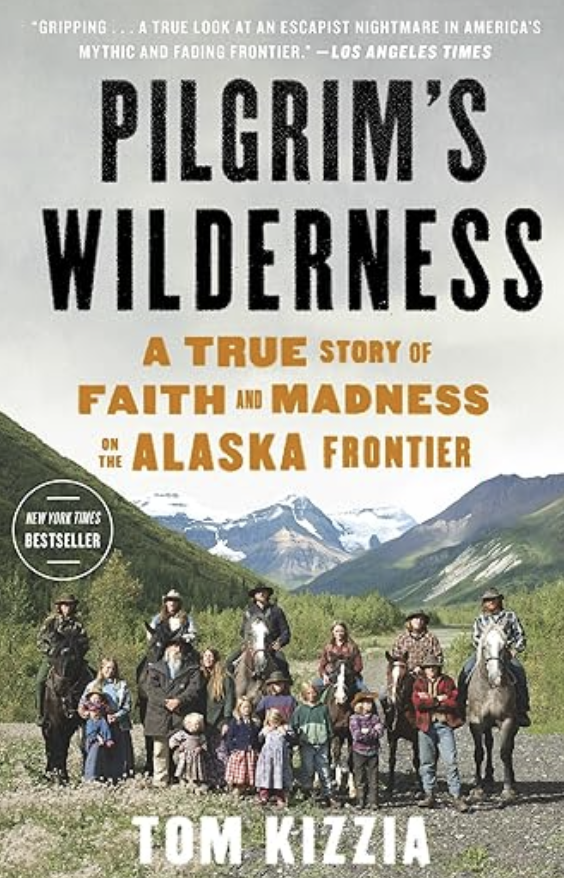
In this episode journalist and author Tom Kizzia recounts his journey from arriving in Homer in the mid-1970s and reporting for the Anchorage Daily News. We discuss the newsroom environment, land management and oil politics of the 1980s, as well as his books, especially Pilgrim's Wilderness, his 2013 bestseller about a cruel patriarch who attempts to insulate his family from reality near the town of McCarthy.
We also talk about changing attitudes toward development, national parks, tourism, and the challenge of balancing storytelling, objectivity, and empathy.
On Step Alaska — Interview with Tom Kizzia
On Step Alaska: Tom Kizzia, welcome to the podcast.
Kizzia: Thanks. Nice to be here.
On Step Alaska: So you came up to Alaska in the mid-70s, came up to Homer, and then worked for the Anchorage Daily News from Homer through the 70s and 80s. Is that right?
Kizzia: A little complicated. I started out at the Homer News right out of college in '75. And then in the early 80s, I moved up to Anchorage to work at the Anchorage Daily News. And then it was in '89 during the spill when I came back to Homer and kind of had the best of both worlds. From then on, I was an ADN reporter but based in Homer.
On Step Alaska: When I think about great times to be in Alaska, I think about statehood and what that would have looked like — the before and after. And then the 70s are so appealing because there was so much going on. You had ANCSA at the beginning, you had ANILCA coming in at the end, and it just seemed like a really wild time to be in Alaska. My family moved up in '86, and that was kind of the blank check education era — both my parents were teachers. So when you moved up in the mid-70s, what was Homer like? You had what, 1,500 or so people? What was the vibe when you got there?
Kizzia: Yeah, it was a funny place. It seemed like I had discovered this remote spot where nobody had ever been before — it kind of felt like that when you showed up. There was no big chamber of commerce waiting for tourists to show up, welcoming you with signs and open arms. It seemed kind of indifferent to whether you came or not. There was one guy who had a boat in the bay and you could pay him to take you sport fishing. And it seemed like, really? Who would pay to go sport fishing? Why would that work? So it was definitely a different sort of vibe. But it was also, you know, in addition to the political issues with the land claims and the parks, that was when the pipeline was being built. And so there was all this money arriving, and population and change were in the wind. Everything seemed like it was all tumbling together and happening all at once. That made it a great time to be a journalist.
On Step Alaska: Yeah, you wrote that Homer was different then — old-timers were uneasy about newcomers and hippies. There's always been a thing about being a newcomer. Do you think Homer has softened a little bit about newcomers, become more welcoming? Or maybe — how long did it take for you to kind of shed that newcomer stink?
Kizzia: Yeah, it took a couple of years to establish myself. It's really more a question of how I felt about it. I felt like I was part of it when I finally bought some land and built a cabin and sort of learned the basics of carpentry in order to put it up and just kind of settled in at that level. But it was changing and it changed fast after that. After the big oil fight in Kachemak Bay, it became much more of a tourist-oriented place where newcomers were arriving. And pretty soon, it wasn't long before I found myself being one of the old-timers — that's just the way it goes. So yeah, there was a lot of turnover. And I think one of the things that's made it an attractive place is that a lot of people have traveled the world, had interesting jobs and educations, and then come over the bluff and said, wow, when they get to Homer and move in. So there's a kind of worldliness to parts of the population that makes for good art galleries and restaurants and things. It has a little bit more of a cosmopolitan flair than you would think a little town at the end of the road might otherwise have.
On Step Alaska: Has it stayed pretty true to its roots? Because it is way out the road — you're hours from Anchorage. So that can work both ways. Has it been infiltrated by some of the bigger city issues, or does it still have that really quaint small-town vibe? I've been there a couple of times — once when I first moved up, and another time a couple of years ago when my wife and I went on our honeymoon up there. When you visit a place, it can be difficult to get a real true feeling for the vibe and what people who live there feel like. So is it staying true to its roots?
Kizzia: Yeah, I think in some ways it really has, because it is distant from Anchorage — far enough to require a commitment to drive down. But I think the other thing that's really saved the town is the Jones Act and the fact that cruise ships can't really hit it in a big way. We get a couple of cruise ships, maybe half a dozen in the summer, that are on eccentric itineraries, but we don't have the kind of volume that you get in Ketchikan. That volume can be much more transformative when you talk about a community's vibe. We also have the benefit of the Homer Spit, and all the summer activity seems to take place out there at the end of the spit. I've described it as a kind of lymph node for tourism. So it all happens out there and you can avoid it unless you've got to go out to the harbor, or you can go relish it. I remember my daughter really wanting to work out there and I thought, why would you want to go out on the spit in the summer? I was usually avoiding it. And then I realized half her class was out there working jobs and there was a whole underworld of high schoolers having a great time out there. Now I get it.
On Step Alaska: Yeah, a great place to grow up. The types of jobs that a teenager can have up here can really help with their confidence and growth — you're not just stereotypically flipping burgers, you're dealing with tourists, you're being a kayak guide or whatever. So it's super interesting. When you moved up and you were writing stories, did it take a little bit to adjust to the style of the town and the types of stories you were getting? Maybe everything was a novelty to you but just very ordinary for Homer people.
Kizzia: Oh, I got really excited as soon as I got here. It just seemed great because Homer was in the midst of a major battle between the sort of old guard chamber of commerce, which was excited about oil leases the state had sold right out in the bay, and the whole commercial fishing fleet, which was up in arms against it. So there was a huge environmental fight going on, but it wasn't environmentalists who were part of it. It was sort of this blue-collar fleet against the old-timers pushing this notion that all development will be good for us. And it just broke out in so many ways. There were so many stories to put in the paper that I got really excited right from the start. That whole year was incredible, and it ended in the most dramatic fashion possible — the oil companies screwed up and had an oil spill of their own on their supposedly flawless jackup rig that was parked off the spit. That forced the legislature's hand to turn around and buy the leases back, and the fishermen won. It was just an amazing drama. It was like a TV miniseries. And here I was writing it in real time. That was pretty exciting as a new guy in town.
And then of course figuring out everything else going on in town — I wasn't perfect at that. I remember going by the high school saying, wow, look at all those cars, I wonder what's going on there. And of course it was graduation. Now having had two kids go through the high school, I realize what a big deal graduation night is and how the local weekly should be there. So I had to figure stuff out, but it was a great experience.
On Step Alaska: And from then on through the 80s, all the stories that were happening in Alaska — what was always the goal for you through your whole career?
Kizzia: It was always finding stories that captured what was happening in this historical moment in Alaska.
On Step Alaska: Context can be really important, and today you can just do a pretty simple Google search and find out what else has been written. How did you get the foundational background information that you needed for those stories back then? Was it just talking to old-timers? How did you make sure the story was told with the right context?
Kizzia: Yeah, it's kind of hard to go back and remember how I did that, but there was a lot of talking and research required. And I also saw these as sort of national issues — the pipeline and the parks. Anilca was passed in 1980, but through the 1970s, the D2 question was front and center in everybody's mind: how many parks are going to be created, what's the acreage, what are the rules going to be? That was really one of the big issues throughout that period. And I came up to see Alaska initially as a mountain climber on a summer trip from college — we did a first descent down near Cordova on a month-long trip. And I thought, wow, I want to come back and start my career here as a journalist. That turned out to be my whole career.
On Step Alaska: You were doing some crime writing as well — was the police beat your first beat, and then you kind of morphed into the political and environmental stuff?
Kizzia: Yeah, when I went up to Anchorage in '82 to start working at the Anchorage Daily News, they offered me the oil and gas beat. Because I'd been in Alaska for a while and wasn't a new reporter, I sort of understood the pipeline and all — that was a prestigious beat. The only other beat that was open was the police beat. And I kind of surprised them by taking the police beat. But at that point in my career, I still felt like I was learning to write. As a writer, I wanted to be out on the streets writing human interest stories and dramatic stories. I didn't want to spend my time studying environmental impact statements and interviewing white-collar executives. So it was a great choice. It was kind of a fork in the road and it affected the kind of writer I became.
On Step Alaska: As an outdoors columnist, I kind of romanticize the newsroom experience. You watch those movies — whether it's a Woodward and Bernstein documentary or even Fletch — and you see people in the newsroom talking about ideas, editing, discussing things, and there's this energy. I only experienced it a little bit in college. What was it about how journalism functioned in the 70s and 80s that allowed you to write good stories and grow as a writer and report on these really impactful topics?
Kizzia: Well, it's really true that that newsroom energy was wonderful and uplifting. And it's too bad — I think now a lot of newsrooms are made up of reporters working remote, working from home, and there isn't that kind of cyclone energy anymore. Especially when there would be a big story breaking — a plane crash or something. It can be gruesome if you step back, but if everybody's running in different directions and there's a captain pointing people where to go, the energy level is pretty remarkable. And you learn from one another too.
On Step Alaska: Yeah. I was a junior or maybe a sophomore in college when 9/11 happened. I remember going to the paper just to see what was going on — you have all these fellow college journalists trying to track down whoever. I wrote sports, so we were trying to track down former U of A basketball players who were in Manhattan. And you just feel that need to tell the story and get the information out there. It was a tragic event, but my memories are of that cohesiveness and telling the story and doing your duty to the reading community.
Kizzia: It was kind of true during the oil spill too. I felt like journalists were some of the only professionals who were able to do something constructive, because there was so much ridiculous energy going into, quote, cleanup — boats running around and everybody running this way and that but really accomplishing nothing. At least we were able to use our energy to document what was going on and talk about the shortcomings.
On Step Alaska: Would you say that's kind of the biggest thing you covered? Obviously you've written multiple books, but as a news event, is that the biggest thing you contributed to?
Kizzia: Yeah, I guess in terms of a single event like that, yeah. But going out to McCarthy in 1983 as a reporter to cover the massacre out there — the mass shooting, six dead in this ghost town — and I was the only one out there. That felt pretty momentous and powerful. One of the reasons I liked being in Alaska as a journalist was because I liked to be out working on my own, not in a scrum of reporters holding microphones up trying to get a snatch of a quote from somebody walking by — that image you have of journalism in Washington, D.C. For two years in the 80s at the ADN, my job was to go off into the bush and write about what it's like for people living out there.
On Step Alaska: And that was your first book — published in what, '91?
Kizzia: Yeah, I did the traveling in the mid to late 80s and then had a chance to take a couple years off and work on it as a book. That's where I learned so much about writing.
On Step Alaska: It's wild that Alaska is so diverse. You can call yourself an Alaskan but I grew up in Southeast Alaska, so I feel much more like a Southeast Alaskan than any other type. You spend time in Fairbanks and that's a totally different world. Homer, Anchorage — all those different locations are completely different. So as you were traveling around, what was maybe an obstacle for you as a writer to earn the trust of the local families you were visiting?
Kizzia: Well, a lot of what I was writing about was in the Native villages, and I had to learn how not to push myself there, but to be kind of quiet and listen and watch and learn. Stories didn't always yield to aggressive questioning. In fact, that would make people clam up. So that was a lesson learned. But I was on that knife edge of — I was an Alaskan exploring Alaska, getting to know my home better, but I was also an outsider. White colonist type guy from the big city coming into this Native community. So I was aware of my role as an outsider too, and I would sort of flip back and forth. In the book, I kind of worked on that issue — am I part of this? Is this my home or am I a visitor? And there was not one answer to that. It's a tension, and working that tension was the writer's job.
On Step Alaska: We moved up to Klawock in '86. My dad was a music teacher and he started the concert at 6 p.m. The tradition in town was kind of you show up when you show up — you don't have to be very precise. So dad started it right on time and some of the parents were still filing in and a few were a little upset. But once they found that he was starting at 6 p.m. for the sake of the kids, that was accepted and they definitely liked it. My brother and I were the only blonde kids in the school, but it was just cool to see how accepting and welcoming it was. When I go home now — I live in Ketchikan, but when I go back to Klawock, the elders still say welcome home. It's incredibly welcoming as long as you don't do things to betray the trust. If you go there with the best intentions and an open mind, and you don't try to force yourself upon these smaller communities, they're very helpful and very welcoming.
Kizzia: Yeah, and that was something I wanted to capture in my pieces — the kindness and the warmth of those communities. Two years ago, I wrote a long series for the Anchorage Daily News as a freelance deal about Sitka and a story that happened at the time of Sitka's founding, when the American flag first went up, the taking of that land from the Kwáan of the Tlingit. All of that Southeast history I really didn't know much about. It was like coming into a new state almost. It was a great opportunity — Alaska is my home, but I really didn't know much of that history. And to be able to jump into that, with such a good story to tell within that realm, was a great opportunity.
On Step Alaska: Yeah. You go to Petersburg and it's just Norway. You go to Sitka and it's Russia. Then Juneau and you get a lot more of that. There's obviously the underlying Indigenous cultures that have been there for thousands of years. But because of the islands, you just have these unique individual cultures and histories. It's super interesting to travel around and see that here in Southeast.
Kizzia: I told this story before — I have a friend who lives in a two-bedroom apartment in Tribeca in New York City. She had a dream once about pushing through her clothes in her closet and discovering a trap door that opened onto a third bedroom she never knew she had. And to me, that was what it felt like discovering Southeast — this whole realm of Alaska that I didn't really appreciate until I found myself in the midst of it.
On Step Alaska: So you'd been in Alaska for over a decade when you wrote that first book. And then how did having that experience in Alaska help you write it, and later on the books about McCarthy and the Pilgrims? If that had happened earlier in your career, how would you have handled it?
Kizzia: It would have been hard to sustain a book-length narrative earlier in the career, I suppose. When I was writing The Wake of the Unseen Object, the first book, I was trying to convert what had been a series of stories into a kind of travel narrative. In the late 80s, the genre of literary travel writing was front and center in all the bookstores — Bruce Chatwin and Jonathan Raban and others well known in that realm. So I read all those writers avidly and sort of taught myself how to do what they were doing. That was transformative for me. Then when I came back to work at the Anchorage Daily News after having written that book, I was a different kind of storyteller.
And the Pilgrim family story — I was drawn to it because there was this family out in McCarthy that was fighting against the National Park Service. I thought, what a great way to talk about the coming of the parks and the old frontier mentality that was lingering in Alaska and the clash between the two. And this one family that seemed to me self-consciously trying to present themselves as something out of the American past — this pious Christian, simple-living family. So I was covering it initially as that story. And then when I got out to see them and realized what a cult the father had built around his 15 children, the story shifted into a much darker place. Once the children escaped, I realized there was a book to be written, but it really had to be the kids' story — their effort to come to consciousness and escape this world where they had never been taught to read or write, had never seen television or had friends. The only book in the house was the King James Bible, and their father would read it to them at night as their big entertainment. And of course he was reading just select passages to reinforce his patriarchal abuse. The book would only be palatable if it was a book about the kids escaping and not a book about a creepy dad.
On Step Alaska: You mentioned that you had to have a good level of self-awareness when going to these rural communities and talking with people. In that book, when you had the chance to talk to Papa Pilgrim, you had to be very aware of his aura — I don't want to say positive, because it clearly wasn't — but you had to be self-aware enough to know not to push, but also to get him talking. How does someone develop those people skills to allow someone to let you in while also being objective and finding the truth?
Kizzia: Well, I was the right person at the right moment, I guess. I could sense his narcissism when I was with him, and I could play to that to get him talking. But I don't know that it was any deep, dark secret. He thought — because I have a cabin in McCarthy and he had snowed a lot of the community into thinking he was what he said he was — that I would fall for it as well. At least he was hoping that would be my reaction. And so I didn't disabuse him of that. I didn't express a lot of skepticism about what he was telling me in that first meeting. Of course, once I wrote my story, I was banished forever from his sight. I got the full cult leader attack mode directed at me.
On Step Alaska: What toll does that take on you? The police beat can be kind of energizing — you're reporting on people making poor decisions. But later on you're writing stories like this. How do you psychologically remove yourself, think about the kids, think about the impact? As you dig deeper, the connections to the Kennedy assassination — it's an incredible story. How do you keep your mind set on seeing it through to the end, knowing there's so much darkness involved?
Kizzia: Well, it's similar to what I was saying about being an insider and an outsider. You're partly excited by the stories you're telling because they're great stories, and you're also kind of afraid of them. I talk about that in the beginning of Cold Mountain Path, the history of the ghost town of McCarthy. I tell the story of going out to cover the mass shooting out there and getting to talk to one of the few people still alive who had lost his wife in the shooting the day before. He told me a lot about the people who had been killed, and it was amazing stuff. And I got on the plane to fly back to Anchorage on one level really excited in a bizarre way — I think in a way that other journalists would understand — where I have an amazing story and I really got some good interviews and I can make this come alive for people when I get back. And this is going to be great. But the man I talked to also asked me, when I landed at Merrill Field, to tell his son who worked there as an airplane mechanic — he hadn't been able to get through to him — could I go by and tell him that his mother had been killed.
So on one level I was kind of perversely excited to be telling the world about these six people, but then the personal responsibility of having to go tell a young man that his mother was dead was just terrifying to me. Deeply, profoundly upsetting. And I was kind of gyrating between these two emotions as I flew back in this small plane over the Chugach Mountains, bouncing around. The bouncing seemed emotional as well as physical. And as a writer, you write about both of those things and try to be honest about the tension between the two. You don't go all the way one way or the other.
On Step Alaska: Is it more important to be really, really curious or is there an element of needing to be almost obsessed to make sure you cover all the angles? Which serves a journalist better — deep curiosity or an almost obsessive pursuit of the story?
Kizzia: I'm not sure I follow — I think they're the same thing, the curiosity. But you do learn in a long career to trust your instinct when you say, I really need to make one more phone call because I'm not sure about this fact. You learn to push that, stay late, make those extra calls, double-check everything. When you're a young reporter and you think you've got it, you often don't have it nailed down. And it's hard, because sometimes you're calling the person you're writing an embarrassing story about and it's going to be an uncomfortable conversation. But you learn that it's even more uncomfortable to not make that call and then be embarrassed by something that's wrong in the story the next morning. So you do learn to push deep.
On Step Alaska: When you're writing one of these stories that has a lot of depth, I've heard both that the story kind of writes itself, and also that some people try to fit a narrative into a story that doesn't really match. How do you not overwrite something? How do you include yourself to help with the narrative but not so much that your opinion ends up being a bigger part of the story than the story itself? In contemporary society we have so many purpose-driven journalists who start with a conclusion and then mold the story to come to it. That's, I think, one of the reasons why there's so much distrust in parts of the media today. So how do you let the story tell itself?
Kizzia: Well, I think one thing is that you find really good writers to learn from. You train yourself by reading the greats, and the greats are the ones who don't push their faces into the stories. I learned early — and this is more from my reading initially, then proved it in my writing — that the more powerful the emotion, the more understated your prose has to be. And this is also a lesson of the police beat. If you're writing something simple and minimalist about something terrifying that happened, the reader just leans in and starts filling things in. But if you're saying, and then it was a terrible thing, and there was blood dripping everywhere, the reader backs away and says, ugh. So by learning to work that emotion, you can really pull the reader into the story. And you learn that sticking yourself in there excessively is going to undermine your goal, which is to write a story that grips a reader.
On Step Alaska: One of the things I liked most about Pilgrim's Wilderness was the narrative of land use — bringing that whole issue of what the park service is supposed to be, and then you have a new context, a new issue. All of a sudden the bulldozer becomes a huge symbol of what are we going to do with this land. Rather than turn that into a more political or ideological narrative, I like that you let the story tell itself and the bigger issue was the park. A lot of people would be tempted today to try to make this a social commentary rather than let the story be the thing. So as far as the Park Service and land use as a symbol, what did you see leading up to that? Between the 70s and the early 2000s when the Pilgrims moved up — how had Alaska's attitudes toward land use adapted or evolved in those two decades?
Kizzia: Yeah, there was a lot of controversy in the McCarthy area in the 70s over the creation of the park. But by the time the Pilgrims showed up, there had been a park for 20 years and he was trying to push it back to the pre-park days. There were old-timers around who responded to that, but there was a whole superstructure of park management at that point. You can't really go back to the past — that was one of the lessons of that period.
The famous story that gets told often is Seward, which had a staunch opposition to creating Kenai Fjords National Park. And then once it got created, the community did a 180 and over time built up a whole tourism industry around their proximity to this national park. I did a story once where I interviewed the head of the chamber, who was fairly new to town. I asked about why the town was so against the park back in the day. And he thought it was the outsiders who were against it at the time. He didn't understand that it was his predecessor — it was the Chamber of Commerce, the establishment — that was the voice against the park in those early days.
So park acceptance has changed over time. But then again, you've got AIDEA and the voices of development pushing the Ambler Road out into the untouched parts of the Brooks Range, seemingly without any discussion of what's being lost — what's the potential loss in putting a road into the last unroaded mountain range? I think history will catch up with Alaska on that. Those wild, unroaded areas we have to give the world are much more important than a couple more holes in the ground for minerals they can get in other places. And I feel like the AIDEA board is kind of the last vestige of manifest destiny — this 19th-century attitude that we can rest when we've got roads to every resource on the continent.
On Step Alaska: Yeah, and it's not even an apples-to-apples comparison, because the Dalton Highway goes north to the oil fields and the oil is pumped through the pipeline. With the Ambler Road, you'd be trucking ore 218 miles down the Dalton — that's a massive amount of traffic. They've done studies on the fugitive dust, the contaminant dust that comes from the trucks hauling ore. It's going to contaminate in a way that's very different from what you experienced with Prudhoe Bay, because you're not trucking the oil south. And open pit mines are obviously way different from drilling for oil.
Kizzia: It's also interesting to go back and review the debates over the Dalton Highway, or the Haul Road as it was known in the 70s, and the promises to keep it closed — that it would be just an industrial road and wouldn't change things much, just supply trucks going up and down. And then because of its funding sources, they said, well, we can't keep the public out, that's not legal. And so suddenly, with a wave of the magic wand, it became an open road. I think the same would happen inevitably with the Ambler Road. There are going to be hunters and tourists, tourist vans driving from Anchorage and Fairbanks out to see the Ambler country. I'd like to go out there myself — but it's going to be so different if there are trains of RVs and hunters with their all-terrain vehicles going after the caribou. You've just got to look 20 years into the future and not just two years.
On Step Alaska: Yeah, we're kind of looking back into the past down here in Southeast, seeing the amount of logging that was done on state land, corporation land, federal land. The appetite for logging in Southeast has really dwindled. There are some ideas about focusing more on second growth and helping mills transition to that. But the idea of taking more old growth at a loss and shipping it overseas is something we're pretty far past. We've definitely transitioned to tourism. We've got Misty Fjords that people want to fly out to, and a lot of stuff people want to see. The pristine habitat is far more valuable than trying to cut deeper and deeper into timber that's so important for the ecosystem.
I was a writer on board a couple of cruise ships during COVID, just to see what the cruise ship thing was like. And we went into Glacier Bay. It was exciting to be up on the top deck and see the enthusiasm of the people there for seeing Alaska and wilderness. Half the ship was down in their staterooms nursing hangovers, but those who were excited about being in Glacier Bay were truly having the time of their lives. Even though I was kind of in tears at the same time, looking at the shrinking glaciers, seeing it as a lost world, while they were seeing it as timeless nature. We had different views of what we were perceiving, but it was nice to be in their presence.
Kizzia: Yeah, it's conflicting. As people who've been here longer, we've seen what's been lost and maybe appreciate where things are going — the shifting baselines of fish populations and caribou herds. Someone else comes up here and loves it and appreciates it, and we can see just how much better it is as an intact ecosystem compared to what people experience on the East Coast. It's kind of refreshing — yes, this is still incredible and still very grand and still extremely wild and definitely to be appreciated. But also, like you said, there are those warning signs. What have we lost and what can we do about it? Can we do anything at this point?
On Step Alaska: Yeah, it can be conflicting. So what else is on the horizon? Another book, another writing project?
Kizzia: Well, I still have that great tie to the ADN so I've been able to write some things for them. And I'm thinking about the birthright citizenship case coming up at the U.S. Supreme Court, because my Sitka story was about the first girl born there after the U.S. flag went up. Her parents were not U.S. citizens — they were German Jews who had immigrated. She was born there a year after the 14th Amendment was ratified, so she had birthright citizenship. When she was six years old, her parents for family reasons changed their plans and went back to Germany. So she grew up in Germany and in the 1930s found herself trapped there as a Jew. She couldn't get a visa to the U.S., but in 1938 was able to get a passport from the U.S. Embassy because of her birthright citizenship and made it out just before the war. And that was, as I said, the first white girl born in Alaska after it became a U.S. possession. It's an amazing story and kind of drives home the importance of that 14th Amendment. I'd like to do something more to address the issue as it's shaped itself this past year under the Trump administration's effort to do away with birthright citizenship.
On Step Alaska: And that was the eight-part series?
Kizzia: Yeah, it was an eight-part series about the story of Sitka's birth as an American town — who were the Americans in there. And it turned out half the commercial part of the town were European Jews who had come to the U.S. and followed the frontier up there. It's not sort of our popular image of the frontier, but it's the reality. And that was a time, as I said, when they were tearing the land away from the Tlingits. There was a fence around Sitka town and all the Native people lived on the outside and had to be out by sundown. It was pretty interesting to go into that period and that world.
On Step Alaska: Outside of your own books, what would be two or three of your top Alaska books — books that take place in Alaska or capture the essence of Alaska — that you'd recommend to people?
Kizzia: I always liked Arctic Village, Robert Marshall's book about Wiseman in the 1930s. That was one. And like most writers of my generation, I'm a big John McPhee fan, so Coming Into the Country was the book. Funny, actually — it was in 1975, I was in the Brooks Range with my college buddies, and that was the year I was going to stay. I had just graduated. And while I was up there, I was reading John McPhee's book The Pine Barrens, a kind of cross-disciplinary look at this rural area in New Jersey, which is the state where I grew up. I thought it was a really interesting book. And then while sitting on a boulder up there in the Brooks Range, with the notion of getting a job when fall came and staying in Alaska, I thought, wait a minute — I could do for Alaska what John McPhee did for the Pine Barrens. I could write this big, broad book about the history of where we are and who the people are. And so I was really excited. That was kind of my inspiration for staying. And then about a year later, my New Yorker subscription arrives and there's part one of John McPhee's Coming Into the Country. He was doing for Alaska what he had done for the Pine Barrens. It was a good idea, but I ended up having to wait a generation. Pilgrim's Wilderness felt like it was kind of addressing those issues that he addressed about change in Alaska, but looking at it pretty much a generation later.
On Step Alaska: Yeah, those are two great books to read back to back. I've really enjoyed reading your stuff and then going back to Coming Into the Country. That's just a good couple weeks of reading right there.
Kizzia: And then I finally had the chance — because of Pilgrim's Wilderness — to write a few stories for The New Yorker. And through my editor there got in touch with John McPhee and told him that story, and he thought it was pretty funny.
On Step Alaska: That's awesome. Well, thanks again for being on. I really appreciate it. Anything you want to add in closing, or pitch for the books? Where can people get them?
Kizzia: No, I think they're around. And I'm looking forward to seeing your book. When you got in touch, I looked it up and saw you had a really great review in the Anchorage Daily News in February when I was traveling and just got back to read it. So I'm excited to see that.
On Step Alaska: Yeah, there's always a nervousness — you look up to the journalists and writers you admire and the imposter syndrome starts to ooze out a little bit.
Kizzia: Well, I always feel imposter syndrome when I'm out fly fishing. Which I've done a lot. I'm one of the few people in Homer who never bought a boat, because to me it wasn't fun to ride around in a boat with a trailing line. I wanted to go down to the Anchor River or elsewhere and stand out there and throw at blank water for a while. That's been my side passion.
On Step Alaska: So much fun. Yeah, great trout rivers there. My wife and I did that with fly rods. I think we were the only people on the Kasilof and the Kenai who were fly fishing — everybody else was doing the flossing thing. But we had our switch rods out there, casting and not catching anything, but it was a lot of fun.
Kizzia: Yeah, a little flossing is fun too, to get your fish for the freezer. Do what you have to do.
On Step Alaska: That's right. Can't beat it. That's why I'm here. Thanks again. I really appreciate it.
Kizzia: Great. Thanks for your time.
Thanks for listening. Please share. If you found today's conversation useful, you can go deeper with my writing on Substack — that's where I expand on these ideas from the show.