Episode 514 - Dam the Su?
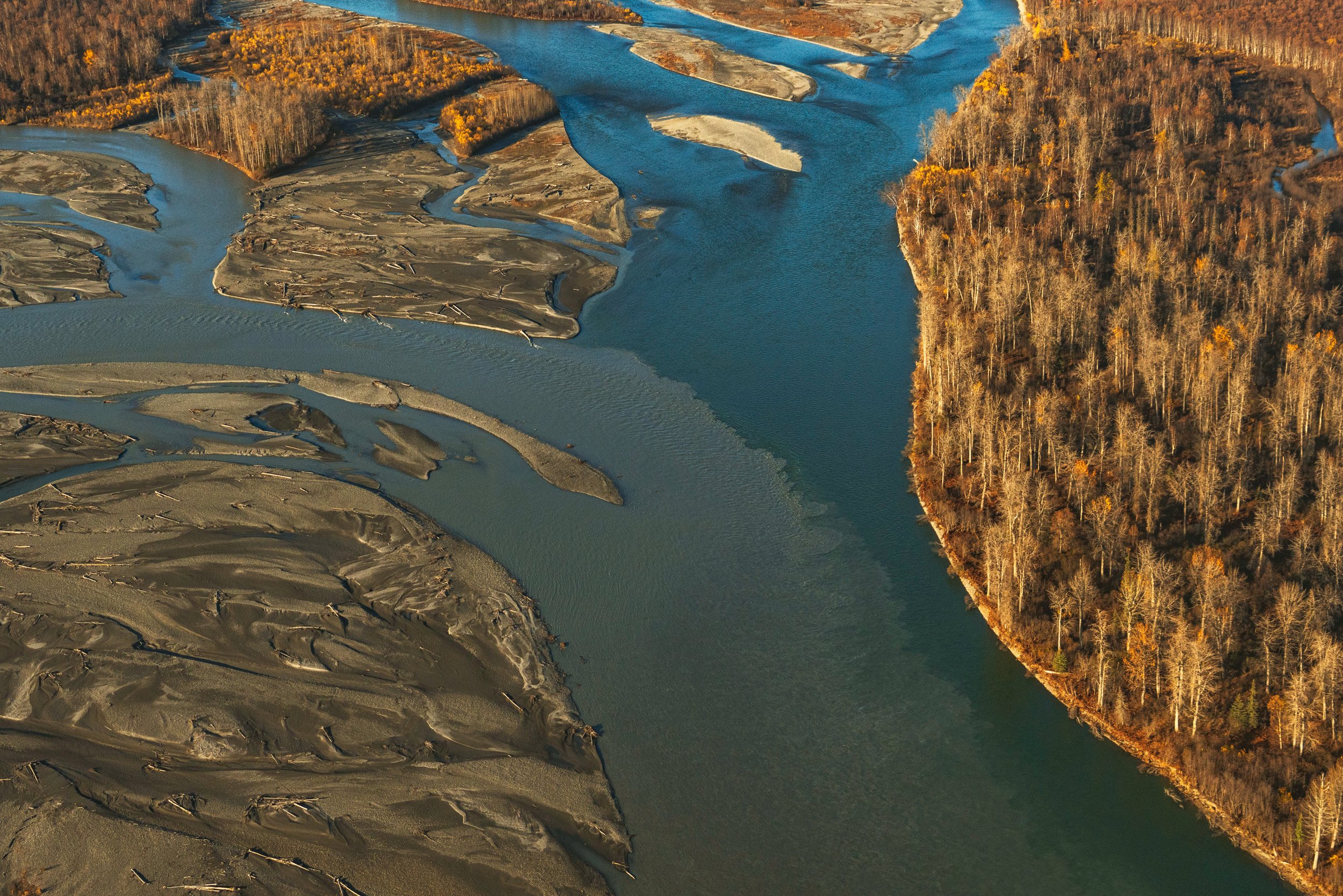
In this episode, Melis Coady (Susitna River Coalition) explains the proposed Susitna‑Watana hydroelectric dam. We discuss its scale, potential impacts on salmon and local communities, and seismic risk. We also talk about the project’s history, funding pressures from public and private investors, and the renewable strategies like distributed wind, solar, and small hydro.
Photo by Sarah Ann Loreth
Podcast Transcript: The Susitna-Watana Hydro Project
On Step Alaska: Welcome to the podcast.
Coady: Thank you, it's great to see you, and thanks for having me.
On Step Alaska: Yeah, so we were just talking off air about summer ending so fast — we always, every year, talk about how it goes so fast. Everybody talks about how fast it goes, and it still does. So how did you spend your summer?
Coady: Let's see — I spent a fair bit of my time out on the trails, trail running. I've been training for a series of Alaska mountain races, and it's all culminating for me: next week I leave for Europe. I'm doing a hundred-mile race around Monte Rosa.
On Step Alaska: Wow, yeah?
Coady: So hopefully all those miles I banked up here will give me some strength in Europe, even though it's probably going to be way warmer, and then the altitude will be something to contend with. How about you?
On Step Alaska: Been building a cabin, and that's just taken up so much of my time. It's a cabin kit from Panabode, but it's a remote build, so I've had to shuttle everything out in my boat. If all the materials were there it would've been easy to just work faster and knock it out, but it's pretty much taken up the entire summer — so I haven't fished, I haven't hunted. But it's been a unique experience, something really, really cool. So I definitely won't look back and regret building it, that's for sure.
Coady: Oh, well — yeah, like what percentage close are you?
On Step Alaska: I start thinking about all the things around the cabin, and if I include that in the "100% completed," then I'm way far away. But I have the coat on the outside, the windows are in, the doors are 90 percent in. There's no stove yet, but there's a roof on — it's a metal roof — so it's going to be dry on the inside, which is great. And the windows are in, so I feel pretty good about it, especially with the climate down here. It's going to be so wet, so I don't feel like there's going to be any issues with staining or anything like that.
Coady: 85, 90? So — good enough for now. Weathertight is a good spot to be.
On Step Alaska: Right, exactly.
Coady: But yeah, it's pretty wild — there's so many things to do during the summer. Have you done the Mountain Marathon down in Seward?
On Step Alaska: No, I've never done that one. I was in Seward a couple of years ago and did the hike up the mountain — I think it was a couple of days after the 4th of July, so the trail was pretty ripped up. But there's a lot of wild runs and trail runs and races around the state — you could spend your whole summer just going to those things.
Coady: That's the goal. But yeah, I've done the Lost Lake Traverse twice, and that one ends in Seward — that's pretty spectacular, it's about a 16-mile race, and you leave from a campground out of town and traverse right into town. So that's beautiful.
On Step Alaska: There's one that my wife did in Sitka a couple weeks ago.
Coady: Oh.
On Step Alaska: It's seven or so miles, but it was a traverse-type thing — a lot of elevation gain. There's a lot of very publicized ones — the Mountain Marathon is very publicized, pretty wild — and then there's a lot of under-the-radar ones that are pretty cool around the state.
Coady: Yeah, I've never been to Sitka, but my daughter has gone to the fine arts camp, and it just — it looks like a special place. So it's on my list.
On Step Alaska: So Alaska is huge, and it's difficult to have an idea of what's going on as far as ecosystems and projects and fish populations and everything. So I wanted to have you on to talk about the Susitna-Watana Hydro Project — that would be a huge dam project. I've got a couple notes here: it's 184 miles from Cook Inlet, 87 miles from Talkeetna. It would be a 705-foot dam creating a 23,500-acre reservoir — that's 36.7 square miles, and I do English, not math, so I'm not sure these numbers are working out, but that would be like eight times the size of Ketchikan fitting into that footprint. That's a pretty substantial thing. How were my numbers — how was my research?
Coady: Pretty good, you'll see some scattering, but that's ballpark. I try to put things in scale for different folks. Coming from Ketchikan, I know that you all have such successful hydro projects with Swan Lake and Silvis Lake — I've been up in the mountains above those places, and the footprint of those projects is quite small. So when we talk about being opposed to a hydroelectric project, and you talk to people from Southeast, they just think you're nuts — they're like, we love it, we've got reliable energy and it's affordable. Is it your senator or your representative — Bynum, in Ketchikan?
On Step Alaska: Representative.
Coady: I think — okay, yeah, he has kind of a long history of working with the utility there and is a huge proponent. And somebody I worked with had talked to him about this project — he's like, "oh, I'm just a big hydro fan." And they asked, "have you ever seen a large braided glacial river?" You have to come up and see this to know how different it is. And when you talk to people from the Lower 48, when you put it in perspective, you say, "have you ever seen Glen Canyon? Have you ever seen the Hoover Dam?" Because that's what we'd be talking about for Alaska. We don't have anything like that to point to, and globally there's not a lot of infrastructure at this latitude built like that. So it's important for us to have people understand specifically what this project would mean, and where it's sited. It would be a defining moment for this state to build something like what they're proposing.
On Step Alaska: Yeah — Southeast — defining it in a bad way. Yeah.
There are a lot of hydro plants in order to generate the amount of energy we need down here — there's Swan Lake, and three different ones around the Ketchikan area. It takes a lot because you have these smaller mountain lakes that all culminate together. You're not disrupting salmon habitat — Swan Lake specifically, you look at that river and think, oh yeah, no fish is getting up there. They're incredible fish, they can get into some wild places to spawn, but there's no way you're disrupting any salmon flow there. But when you look at the Lower 48 dams, as you mentioned, huge dams — I think about salmon, and I also think about dams that have been there a long time accumulating a tremendous amount of sediment, so the capacity decreases over time. So what are some other things people need to know specifically about the impact this project would have?
Coady: There's a couple of things you said that are interesting to me. What we hear from folks is, "oh, well, this is likely above where salmon would spawn," so in their minds that makes the proposed Susitna-Watana site more attractive. But the thing is, the entire intent of the project is human calculations around water release to create electricity — that would mean incredibly large releases of water in the winter and a fraction of normal summer flow. So for a large section of the watershed you're reversing the system — affecting the speed, the turbidity of the water, how much natural sediment is in it, the temperature regime, whether it freezes in the winter. And they're not making these water-release decisions based on what the ecology of the ecosystem needs — they're doing it based on energy demand. It would impact all of the habitat below that point. This is Alaska's major free-flowing, intact river and ecosystem — and it's not just my backyard, of course Talkeetna will be heavily impacted; it's hard to see, with the projected flow rates, how boat operations, fishing operations, rafting companies in the summer, and dog-mushing tours on frozen rivers in the winter wouldn't largely go away. Of course I see it through the lens of Talkeetna, but we're a small town — this is the backyard for all of Alaska's major population centers. Everybody talks about "not in my backyard," and I'm like, but it's kind of all of our backyards, it's what we have. And if you don't want to travel to fish, to fill the freezer — this is our zone. So if we destroy this, are we all expected to fly to the Brooks Range or get ocean-faring boats to find our fish? What's the plan? We have existing economies here, and this is where we recreate and why we live here. It's a very consequential decision to sacrifice that to create electricity.
On Step Alaska: Yeah, 180-some miles is really not much when it comes to salmon migration. I was outside Stanley, Idaho, on the Salmon River, and there was a little plaque with a sad story about the lone sockeye that returned in 1992 or so — sockeye going all the way into Idaho, thousands of miles. So saying it's high enough up the river that it won't impact salmon is just ridiculous — we've seen that in the Lower 48, and with fish that go up the Yukon all the way into Canada. Fish are extremely resilient, they go very long distances to spawn. So to say 184 miles is substantial really isn't — that's not much at all for these fish.
Coady: Yeah. And they've really anchored on this — this proposal has come and gone since the 1940s. There's a body of studies trying to understand where the fish are and how they use the river, and there are large gaps — there's only one weir in the whole system, and it's not always working. But in the fish studies they've done, they wanted to know where fish are spawning, so they tag them — it's pretty cute, there's a little movie called Super Salmon, if you haven't seen it, see it. One fish — I think it's numbered 224 or 214 or something — travels nearly 300 miles up the watershed to almost the Susitna Glacier where it starts, eddies out into little streams and pockets, and surfs its way back down, spawning not far from Talkeetna. That's where it was documented in the dam study, and they said, "see, it didn't spawn above the dam site" — and we're like, but everything above it was its habitat. We now have the journey of one tagged fish, and that's our tiniest data window into understanding how this keystone species supports the whole ecosystem — feeding bears, feeding trees. And this idea that fish need some climate agility when they're having a hard time living in or getting out of the ocean, to find cold, clear water — you don't want to shut doors for any of these salmon species. All five species migrate up the Susitna and support the Cook Inlet fishery, one of the more important fisheries in the state.
On Step Alaska: I think I read that in the '70s there were proposals to dam the Yukon River, which is incredible to think about — you'd think Alaska would be untouched by a lot of the Lower 48 nonsense, but as you said, these ideas have been floating around for a very long time. What's been the history, and is this something that might be imminent? Is it more ebb-and-flow, "oh, maybe it'll happen"? We see that with Pebble Mine too — it seems dead, no way — but then people are still investing just enough money to keep it alive. So what's been the history of this project?
Coady: It definitely fits that bucket — it's a zombie that resurfaces almost periodically. You could set your watch to it, about a decade apart — here it comes again, somebody saying we should have built this years ago, but we should do it now, and it won't take that much more money. Specific to the Rampart Dam on the Yukon — I was interested to learn that's the event that brought Don Young into Alaska politics, kicking off a 50-year career representing us in Congress.
On Step Alaska: Was he in favor of it?
Coady: No, he was against it.
On Step Alaska: Okay.
Coady: Yeah — sometimes with Don Young it could have gone either way, but it was going to go whichever way with absolute force.
On Step Alaska: Yeah, I'd read that and it surprised me — I didn't realize that was a launching-off point for his political career, someone so significant in Alaska's history and politics.
Coady: A bit about the history of this dam: the last time it was seriously looked at was the 2010–12 era. To move forward you need a license from the Federal Energy Regulatory Commission, and to get licensing you need to complete studies. They decided you needed 58 studies to understand the impact of the dam and inform a safe, environmentally conscious design. They've completed 19 of those. It's contested and debatable whether those 19 are to a good-enough standard, without errors — NOAA reviewed the data from some of the studies and submitted a critical document into the licensing docket saying a lot of them weren't sufficient, and the Alaska Energy Authority contested that and said they were fine. So, 19 of 58 completed, and what you hear today is, "well, we've already invested hundreds of millions of dollars" — and if you inflation-adjust that, it's a very uncomfortable number. We've invested a lot in the feasibility of this dam, so you'll hear modern-day dam proponents say, "with just a little more money we can close this deal, get a license," and then make all the decisions about completing the dam. But it's like — how much do you double down on a bad investment in a bad idea? And that's not unique to Susitna-Watana; you see it with a lot of other big, shiny megaprojects, whether gas lines or roads. The state doesn't have the bandwidth, the money, or the time to do any of these, let alone all of them.
On Step Alaska: Right — is it private investment? Is it state? Is it both? Where's the money for this coming from? Who's keeping this zombie alive?
Coady: Traditionally these projects are funded by the state in combination with the federal government. When the project last went into hibernation, it was because it was seen as just too expensive — in 2014 numbers the price tag was about seven and a half billion dollars. What we've seen change just in the very near future is: things that used to have to be government-funded, subsidized, and loan-backed are now, with the scale of private equity available globally, being used to attract private investment. So this may be the first time I'm seeing state interest in this project percolate up again — the idea that today and the next couple of years represent a period of easier or expedited permitting, with the support of federal executive mandate, so, "let's push this license through — once we have the license, could we attract private investment for a large infrastructure project like this?" Your window into that is the relationship between the state and Glenfarne on the 800-mile natural gas pipeline, and the shared investment between the federal government and Trilogy Metals for the Ambler Road. You're starting to see more of these private-public partnerships. If you think about the life cycle of this dam — say, most optimistically, that it produces electricity for 100 years, and you turn that into a 50- or 100-year loan to a private equity firm — I'd love the State of Alaska to enter a loan agreement for me for 50 to 100 years; that's a loan a lot of people would want to own. I think that's something that needs more scrutiny — that new framework. Is that a comfortable relationship for the state to have with private equity? We're starting to see those relationships form, and it's unclear how safe that is, how that's being a good steward of state resources for multiple generations. I think people should be doing more analysis, be a bit more cautious before committing to those things.
On Step Alaska: Yeah. I think around the state, even though it's hard to keep tabs on everything geographically, it'd be hard to find someone completely against oil, completely against all those things — it's more, okay, this is one of those things we need, so let's make it as clean and responsible as possible, and make sure it's not coming on our backs. We're seeing that with the natural gas pipeline — I don't think there are a lot of people against it as long as it's for the right price. What they're against is the tax break that's so substantial, and the money lost by the boroughs it runs through. So people who'd be advocates, or at least supporters, are being turned off because it's such a sweet deal for the private company. There's definitely a trade-off, and it becomes so much less attractive when it's clearly in the best interest of these private investors. That's pretty unfortunate.
Coady: I've got a political cartoon brewing in my brain — I'm not an artist — but I picture all these billionaires with their private equity firms, or mineral exploration or oil and gas companies, standing in a bread line outside the statehouse in Juneau, saying, "how many subsidies can you give me?" If they say "I will create jobs," it's like, okay, let me just put money in your hands. And you hear so much frustration from Alaskans who start their own businesses without anyone putting in roads for them, without huge tax breaks and cuts, without any of those advantages. Can any of these industries exist without subsidies? Likely not many of the bigger ones — but then the question becomes how many, and are we giving away everything to draw in these economic opportunities.
On Step Alaska: We see that in Southeast too. If you're not in the cruise ship industry it can be hard to tell as an outsider, but a lot of people are looking for jobs locally, and with 1.3 million tourists coming off the cruise ships, it seems like there should be plenty of jobs. So how are there locals without jobs at this point? Is it because local businesses are bringing people up from out of state? Maybe everybody who wants a job has one, and there are still enough jobs left that they have to be filled by people from out of state. But whenever there's a claim that a project will create jobs — well, for who? People who don't live here, who come up because there's no state income tax, make their money, and go spend it elsewhere? It's not local versus non-local — these are just the questions we'd like answered so we can make a more informed decision.
Coady: Yeah. I think people in Alaska are incredibly practical, do-it-yourself kind of people. We're really conservative with our own personal assets and resources, and we love to see that reflected at the state level, because it's hard to get things here, hard to live here — even getting supplies to your land to build your own cabin, how many loads and runs that takes. And then you see other people come in with ideas who aren't really willing to put in the sweat equity, the risk, that we do — but they want all our state resources for it, and they've somehow gotten into a really good negotiating position with some of our political bodies. I think we're seeing a lot of frustration — I hear that from Susitna River Coalition members. We have members throughout the state representing a really broad network of Alaskans — people who work in oil and gas on the North Slope, who have their own placer gold mines, timber mills, who build roads. They do all of that, but they don't accept the blanket claim that we should just trust other industries to do it as carefully as we do. You hear that Alaska has a "gold standard," that our environmental standards are higher than anywhere else — but that's not true for every industry in every region. And there's a lot being done right now to loosen the things that were built carefully over time to balance healthy habitat and ecosystems, clean water, and clean air with development. You need that push and pull for the state to succeed.
On Step Alaska: Yeah. The environmental standards are great, but no one can promise that a huge mine-tailings reservoir at Pebble in Bristol Bay wouldn't rupture. You can have the best science on geology and plate tectonics, but that very active geology is outside your control — you can't guarantee it. It's so wet there, there's no way it wouldn't leach into the groundwater. That's a promise you can't make, even with high standards. So I think even people who are pro-mining say, yeah, but not Pebble.
Coady: Yeah, and with mining, a lot of the laws and regulations date to the 1800s — think of everything that's changed since. What we see directly in Talkeetna is what used to be called 100-year floods now happening every 7 to 10 years, with these incredible precipitation events. Combine that with permafrost thaw, windstorms in areas that didn't used to see them, extremely dry years and extremely heavy years — an oscillation that hasn't been documented until quite recently. When you talk to people with multi-generational lived experience in Alaska, the message is that the last 20 years were different, and there's no reason to expect the next 20 won't be different too. Are we creating projects agile enough to survive stressors they weren't designed or engineered for?
On Step Alaska: How susceptible would that dam be to seismic activity?
Coady: That's a question I'd really love help answering. There's one geologic study report among the studies required for federal licensing, and the public version is highly redacted. What we do know is there's a major earthquake fault there — geologically very similar to the San Andreas Fault — and there's been an over-magnitude-7 earthquake there in recent history. That's certainly a concern. I shared that geologic report with a geologist and asked for her assessment, and she said the unredacted data she could see doesn't support the report's conclusions that this would be a good place to build. The other thing to consider: this proposed dam would create the largest man-made body of water in Alaska — the stats from earlier in the podcast, 40-some miles long, two miles wide, 700 feet deep, substantial. The weight of that water alone could create its own landslides, and given the soil composition and geology of the area, there's a real concern the reservoir itself could trigger seismic activity. That needs to be explored more, and the public needs an unredacted copy — that's a public-safety issue, not just a salmon-and-caribou-habitat issue.
When one of the project engineers visited Talkeetna for a community meeting I attended — I want to say around 2012 — they came to our high school, we could all ask questions, they had maps and graphs out. Somebody raised their hand and asked what would happen if the dam failed. The engineer said, well, the dam's not designed to fail, we've done all these things. And they asked, but what if? And the engineer said, well, Talkeetna would have a few minutes to pray. Jaws dropped, there was silence, there was fear — we couldn't believe the project engineer had just told us that.
On Step Alaska: Yeah. Wow. Not acceptable.
Coady: No — at least it was a moment of honesty, at least it slipped out. And say the risk is low — low risk is never no risk. You're being a good citizen by asking the hard question: no, but what if?
On Step Alaska: I think that's totally reasonable in that scenario. And even if that never happens, there's still the factual degradation of the ecosystem — there's going to be less opportunity for salmon to spawn, that's a given. So even if the dam stands forever, it's still going to be harmful to fish, and that in itself could be a reason not to build it.
Coady: Yeah. And then you get the doomsayers — our fish populations are already hurting. Yesterday, ADF&G had an emergency closure on coho — they're not even close to meeting escapement for this region, and it's been really low for four years running. You don't like to see a whole life cycle of a species have such poor returns. We haven't been able to catch a king in our backyard since — I want to say 2011 or 2012. My daughter's 15, and she's never caught a king in the backyard, and that was just something we did every year. So people say, well, if the fish aren't coming back anyway, let's just build the dam and finish them off, and I'm — that's not really where we're starting. There's a lot we can't point to as the one thing that will make salmon returns better, but we can work on all the things before we completely give up on the way this ecosystem has worked since there's been fish.
On Step Alaska: Are there other ideas about how to meet the energy needs of that area, and Alaska in general?
Coady: Boy, that's a super tough question. When I tell people about all the disadvantages of the dam, they say, so tell me how we're going to fix it — and I love that they think I'm qualified to answer that, but there are a lot of scalable, dispatchable things we can do now. None of them are a silver bullet that solves everything, but subsidies given to other industries shift, and it was a shame to see them pull away from some renewable projects that were pretty far along in design in our area — wind projects, solar projects, some small-scale, well-sited hydro projects that would create ongoing local jobs and resiliency in a system with a huge transmission-line problem. Even if I waved a magic wand and put the Susitna-Watana Dam in today, at the max megawatt figure I've ever seen proposed for this project, it couldn't go anywhere — we don't have the transmission lines to carry that load in either direction. There's so much more additional infrastructure needed besides the 700-foot concrete wall. But that's less true if we have a more diverse portfolio of things we could be doing now, and invest in emerging technologies that would likely have far less environmental impact.
On Step Alaska: Yeah, like Representative Bynum said, he loves hydro because it makes total sense here — and it's not one project, it's multiple projects that culminate together. Interestingly, the state that generates the most renewable energy in the country is Texas — you'd think, politically, it's probably all oil, but they use renewables because it makes sense. Obviously per capita it's probably not Texas, it's just the most volume — but it makes sense. So what can we do to make sense and make energy, rather than get into political sides where seeing a windmill means something bad? It might be the right solution here — let's put these things together.
Coady: Governor Dunleavy commissioned, early in this last term, a study from the National Renewable Energy Laboratory looking at our systems and energy challenges, asking for a recommendation. The proposal was for a diffuse set of projects, quite a few of them wind, but scattered throughout the state, leveraging different weather patterns — they found that could move the state to a pretty strong renewable portfolio, up to about 76 percent renewables within 20 to 30 years, saving the state billions of dollars. A lot of people have conceptions — and I'm not an energy guru, I'm a watershed-health fisherwoman — but people may have ideas about solar and wind anchored in older thinking, not fully understanding how efficient they've become, or what happens with a well-connected, well-spread-out grid. There's a real fear — we need most of our power in winter, so how does solar work then, what's the firm-load backup? Those are good questions, but there are good solutions: smaller hydro projects used as stored energy backup, natural gas as backup, batteries as backup. But...
On Step Alaska: I remember spending time in California after college — driving to Southern California, there are landscapes filled with windmills, and so many of them weren't running. That fed some of the anti-wind sentiment — people saw all this infrastructure built with none of it running, which created the narrative that they don't work. Once that becomes your idea of wind energy, it sticks, even without an updated understanding of why they were off. But I've seen more of them in the Anchorage area when I land there, and I think, yeah, cool, that's a good idea — let's do what we can with what we have and figure this out.
Coady: Yeah, they're incredibly visible, and people notice when they're spinning and when they're not. But what you hear from utilities here is that, unlike Southeast, the rest of the state is in a real energy bind. I get that — I'm a ratepayer too, I'll see my bills go up and up. We're looking at importing natural gas, and energy is going to be crazy expensive, especially in villages and rural areas.
On Step Alaska: Yes.
Coady: So I'm sensitive to that. And you hear the boards and executives of the major utilities say they're looking at an "all of the above, no stone unturned" strategy — but they've been saying that for so long, and it's like, you're not doing anything. Now we're on the brink of an energy crisis, and it feels self-inflicted, honestly. I think there's a lot of reason for people to be upset about that.
On Step Alaska: I went to Igiagig to do some fishing — a friend invited me out — and their rate was about 90 cents per kilowatt-hour. Absolutely crazy. I think the national average is in the 20-cent range, and down here it's more like 10 to 12 cents — super inexpensive, thanks to the hydro we have. But that's wild — and I can't remember the name of it, but there's an in-river turbine there — I don't know if "turbine" is even right, since I'm not sure if it sucks in water and propels it out or what — it's kind of like an underwater windmill, and it seems to be working, seems pretty cool. I hadn't really heard of it before and haven't seen it widely used — I think RivGen was either the name of the device or the company. Ideas like that — maybe it works there, and maybe it's something that could be used elsewhere. It would be nice to see people come to these discussions with a lot of ideas, rather than waiting for something else to happen, or just protecting their spot as a politician or elected official.
Coady: I know — that's where you can become either ambivalent or really skeptical. You do get the sense that some folks just want an infrastructure legacy, want to build something — you're not sure why they're so adamant about proposing it when the economics and cost-benefit analysis seem so unlikely, but they're still for it. Is it an emotional investment in where we get our energy from? Because I have an emotional investment too. I think putting a dam of that scale in this watershed would be a massive regret for a lot of people. Hydro is popular, it's a major energy source globally, but we have an opportunity to learn from places that have had this kind of infrastructure for 50, 60, 70-plus years and are now trying to dismantle it because of their regrets. It's tricky — we're going to spend a lot of time as an organization refreshing people's memories about these projects, because people who've lived in Alaska a long time say, oh my gosh, the dam again? How many times do I have to sign this letter?
On Step Alaska: There's a generation that didn't hear about it growing up, and they're like, I've never heard about that, that's crazy, how come we don't hear about this more?
Coady: Because we spent the summer doing outreach — we have these little postcards that we'd like to eventually give to the Alaska Energy Authority saying we're uncomfortable with a big investment, or a lot of energy, being put into this project — that's basically what the cards say. Every venue I've gone to, telling people about this project, I get hundreds of these cards. It doesn't take much messaging — a lot of people, especially those who've lived elsewhere and understand how hard it is to undo a big dam like this and get things back on track, respond to it.
On Step Alaska: So, in closing, where can people go to get more information about the dam, or other issues? Where can people find you — websites, social media, whatever?
Coady: Yeah, susitnarivercoalition.org — our website has a lot of information on the dam, probably more than anybody would want. We also have a link to the state library where you can search any of the data or dam reports, and a nifty link where we do a lot of myth-busting on the Susitna-Watana Dam. Am I frozen on your screen?
On Step Alaska: Frozen, but I can hear you.
Coady: Okay, I'll keep going. We also post on social media — we're on Instagram and Facebook, so we'd love a follow, a like. We're an education-focused organization — we really just care about healthy waters and healthy communities.
On Step Alaska: Awesome. Well, thanks very much for your time — appreciate you being on here and chatting about this stuff. Pretty important issue.