Episode 503 - Bristol Bay fly fishing
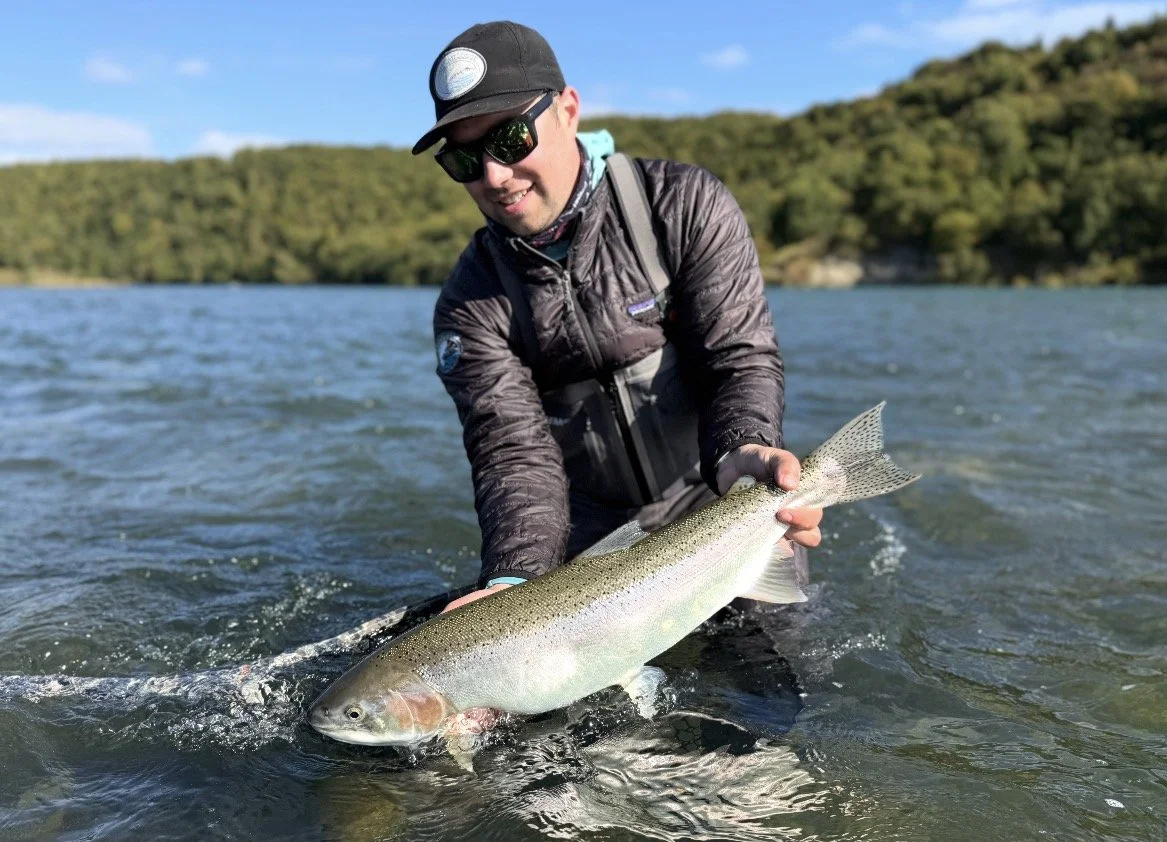
Guest: Dagen Walton
On Step Alaska: So let's kind of deep dive in. Let's start with the rod. What type of rods do you have, and then why? At this point you've been able to cast some rods, fish with some rods, and now you've made the decision to have the rods that you have. What and why?
Dagen Walton: So my rods all have a lot of different purposes, or like a different mode of which I fish. So when I'm fishing out of a boat I prefer a single-hand rod over a switch rod for fishing an indicator rig. It's just a little lighter in hand, but I do prefer a 10-foot over a nine-foot rod.
On Step Alaska: So are we talking like on a boat in Bristol Bay type thing, or drift boat somewhere else? What's the boat situation when drifting?
Dagen Walton: Yeah, whether you're getting rowed somewhere — which we'll do on a versatile day on the Kvichak or the Knack Knack when you're bead fishing primarily, or sometimes you're dead drifting flesh — and doing it under an indicator. But I do prefer a single-hand over a switch rod. Switch rods are great though, it can be great for indicator fishing as well, but I like the lightweight single-hand. And then when swinging flies, I'll always have a switch rod and a spey rod in the boat, whether I'm fishing for myself or if I'm guiding. And between the two, I'm fishing in the exact same way, but I'll make sure that there's some differences between the two — maybe sinking tips or line density. Sometimes if it's windy, it'll be a little bit harder to cast the switch rod, and so switching to that spey rod, it has a little bit more backbone, a little more power. You can kind of punch through the wind or fight it a little bit better. And so the rods that I own now have made me a versatile angler that allowed me to fish different ways depending on the situation.
On Step Alaska: What is it about those rods? Do you like a medium fast action, a fast action? What do you have for the single-handed?
Dagen Walton: I fish a 10-foot NRX Plus. So it's a G. Loomis rod. And it's a six weight and it's got just enough backbone. I feel comfortable landing any fish, especially out of a boat when you're drifting with that fish. The G. Loomis — this is totally ridiculous — but because G. Loomis also makes gear rods, conventional rods, and bass rods, I thought, well, they can't be like a real fly rod company. Because you know, if you do everything then you might not be like a specialty brand. And so when I was first starting off, I had a chance at a lower-end Sage so I went with that because I thought Sage has got to be the fly fishing experts. And that was a great call. But then I realized that G. Loomis does make an exceptional rod, and it's not a matter of — because they don't specialize in one particular method — that doesn't mean that they're not good. This is the first G. Loomis that I've owned, but it is kind of confusing because this is the NRX, and their gear rods have similar acronyms with an X at the end. So it's hard to differentiate if someone's just going to tell you in passing what they're fishing — you might not even know if it's a fly rod or a gear rod. But they make great sticks. I really enjoy that rod. And every top rod company has the equivalent of that rod and they compete head to head really well. The Sage R8, or previously the Sage X, will compete with this NRX Plus that I have in the same weight and length. You might find some subtleties and differences, but I always tell people, friends that come to me asking what they should spend money on — I always tell them don't worry about a nice rod. Get a decent reel, because your drag will actually affect you catching fish more than the rod will. And then once you delve into the sport more and you can differentiate some of those subtleties, you may find more enjoyment with a more expensive rod. But one of my favorite rods is the first rod I ever bought, to this day. And it's still a rod that I use on a regular basis. And it's a cheap Sportsman's Warehouse Fenwick that I just love.
On Step Alaska: See, I've heard both of those things. I've heard both — spend the money on a rod because you're going to be casting a lot, and if you're casting all day you're going to enjoy the experience. If the rod can do what you need it to do, different types of casts, you're not going to get frustrated. So spend the money on the rod because as long as you have a baseline capable reel then you'll be fine. And I found that that application makes a lot of sense when you're presenting flies to creek trout, smaller river trout. But as you get into more like the larger fish, the salmon, the steelhead, all it takes is a cheaper reel to kind of gum up, or even if it's a little bit heavier, the balance is a little bit off. And so yeah, it makes sense that I've heard it the other way — make sure that you get a good reel first and a capable fly rod that you can cast well.
Dagen Walton: Yeah. And I'd agree with that. The reel is so important, regardless of what species you're targeting — that even with smaller fish, like in streams and little creeks and stuff, if you have your drag set correctly for that fish, I think you'll produce more fish over having an expensive rod and a dinky reel. And yeah, I stand by that. It's always the advice that I give my friends, because all rods are going to bend. And if you get something kind of middle of the road or even slightly less than that, it's going to be a pretty capable rod and it'll be affordable for you. As far as reels go — I have a Nautilus. I do, I love it. I have various reels though. I have some Nautiluses, I have some Taylor reels which is kind of a direct-to-consumer company, they make some fun reels, they look cool. I have a Ceracione which is a click and pawl — it's a two-hand specific reel, very heavy. It was actually given to me as a tip, and so it's pretty cool — anytime I use it it brings back good memories. But yeah, those click and pawl reels are kind of a nostalgic thing for steelhead fishermen. It's kind of a niche within the fly fishing community, but they're pretty fun to fish and they can sound crazy. I fish with the Lamson — that was the first nice fly reel I had. It was a Conic I think, and then I got the Guru and I really liked that. There were a couple times where I slipped and fell and just smashed it on a rock and it didn't even bother it whatsoever, so I've kind of been pretty in with them. And then a buddy of mine who came up to Alaska a couple of times got me a Galvin reel because his company supplied the material for them. And that thing is awesome. I've had it — it's a T7 — and I've had that for years and it just works. It's really, really scratched up, but man, the Galvin is such a great reel.
On Step Alaska: I think you'd find that Galvin would be quite comparable to the Nautilus. The times that I've handled Galvins from clients or friends that have had them, they feel quite similar, sound pretty similar — that soft click in and out. And once you get into the sport more, you'll find your own taste and preferences, whether that's a faster or slower action rod, or whether you like a quiet reel or a loud reel. Those are the subtleties that a lot of times won't change your catch rate, but it'll change the way things operate and it will affect your enjoyment. My first reel was a Lamson Guru and I still have it. I love it. And I think Lamson's probably your most affordable reel that you can get for your money. I also have an Abel that I love, that I fish a lot too. What about the difference in — do you have different spools available? Do you ever swap out spools, or do you swap out whole reels?
Dagen Walton: As I've gotten further into the sport, now I'm swapping reels, and I'm fortunate to be in a position to do that. But earlier when I was getting into it, I definitely had a couple spools, and that made things — I mean, you have the same effect between having multiple spools versus multiple reels when you're fishing one rod and switching different lines if that's all you need to do. But now I don't ever go on the boat with less than three rods, and a lot of times I have five. And so you need those extra reels. But having an extra spool is super effective and I did fish that way for quite some time.
On Step Alaska: What about arbor size? Do you get into the large arbor ones? Are you worried a whole lot about retrieval, or is it mostly just about pairing something that's nice and balanced?
Dagen Walton: The answer is yes to that. It kind of depends. With these two-hand systems I'm not super worried about the arbor so much as I am the weight of the reel. Like the Ceracione that I have has a really small arbor, but it's a very dense reel and it provides a lot of good balance when you're fishing those longer length rods. I've done a little bit of saltwater fly fishing and I do feel like in saltwater fly fishing having a lightweight large arbor reel is advantageous. But in the middle of that, fishing trout, I think a large arbor can always help you, but I'm more worried about the balance because it'll affect over the course of the day how tired I get, and maybe how that rod will function because the balance has a lot of effect on your cast.
On Step Alaska: Next would be fly lines. And this is again — when I started off I was kind of first directed to Rio. And you don't really have to go anywhere else it seems like. Rio is really good, but Scientific Angler also is really, really good. Is there much of an option outside of Rio or Scientific Angler?
Dagen Walton: Funny enough, I was just texting with a client today and he just put me onto a new brand of lines — Bridge Lines — and they're two-hand specific. But there's a lot of options out there, more than I think we realize. Because you kind of get put on to Rio and then it's just like that's all you really need. Like all these line companies, unless they're very specific within the sport and only do one mode — like some of these two-hand line companies, that's all they do, they don't have your traditional weight forward single-hand lines — but with companies like Rio and Scientific Angler or Orvis, they kind of cover the wide spectrum of your average angler. Preference-wise, I've used them all and I've honed in on Scientific Angler. I feel like their durability is better over time. I also like that they've incorporated over-lining their line, and it just makes casting and loading your rod a little bit easier with a little less effort. The line does it a little bit more for you. Rio started to do that as well, and other line companies too.
On Step Alaska: I think that having a line that is overweighted is better than going and buying an actual heavier line — like one class up — because of the science that goes into it. Like they say it's half a weight heavy or one line size heavy. Even when it says one line size heavy, their science going into that is going to be a little bit more honed in on what it should be for overlining, rather than you might actually truly overline your rod if you go up a weight on your own without doing your homework.
Dagen Walton: Yeah. I've used some Airflow tips, but I think most of the fly shops I go into are fairly small and so you can't carry five different brands. You kind of go with the recognizable ones. Have you used Airflow at all? Are you familiar with their stuff?
On Step Alaska: Yeah, I don't have a whole lot of their single-hand stuff. A lot of our client rods though have Airflow lines on them. They're super durable lines, which is really nice. And one nice thing in Alaska about Airflow is that they don't deteriorate from bug dope. The DEET and bug dope will eat the coating of most other fly lines, but Airflow — I think it's because they're PVC free — it won't melt under the bug dope. Not that you can watch it melt in your hand, but over time if you're handling it, it will eat that coating away on your traditional Rio lines and Scientific Angler.
Dagen Walton: The water up there is fairly chilly. So would you look for an all-around line, or are certain lines less susceptible to the water temperature?
On Step Alaska: Yeah, the all-around lines will handle your cold water temps just fine unless you're fishing something that's truly cold. I don't see cold water specific lines very much. It's just kind of the normal line — it'll handle cold water. And then obviously when you go into the tropics and stuff, then you get into your warm water lines that can handle the heat, and they won't gum up in your guides when you're casting and that coating won't get soft and gummy.
Dagen Walton: Yeah, that's one thing I liked about the Rio box — you can kind of look at the box and think, okay, this has got a redfish on it or it's got a tarpon on it. And so that seems like at least a starting point when you're looking at the species and trying to match that. And generally it's actually pretty accurate. Have you used the Outbound Short at all?
On Step Alaska: I've seen a couple people use that and people kind of talk about it. It's a shooting line from Rio and a lot of stuff is advertised as being the next best thing. And sometimes it ends up being a good thing. Other times it's just kind of specific but not really worth it. Have you used the Outbound Short at all?
Dagen Walton: So I have an Outbound Short that I have not lined on a reel yet, and the one that I have has a fully integrated line with a sinking tip at the front. Just thinking about it and casting other lines that have been similar to that — it's going to be a little bit heavier casting long distances, but doing that like 30 to 40 feet, you'll be able to get it in one false cast. It's just going to want to fly. But if you're trying to carry really long distances, you're going to have to have a very fast action rod to generate the line speed to keep your proper loops in the air.
On Step Alaska: Yeah, I think they're going to cast really good because it's going to act almost like a single-hand shooting line — one false cast, two at most, and you'll be able to really push it out there. Yeah, I have that on a Lamson reel. And then I got a Sage R8, and I was casting from my skiff to king salmon. And it was pretty crazy because I was sure that this wasn't going to be — you know, people talk about the shooting head and the picture on the front is some guy just absolutely bombing out a cast. Which, okay, whatever, advertising. But I really felt like I had to hold on to the line. I had to be very careful because it was just like flying out. So I was super, super happy and super pleased with that. But like you said, with the fast action, if you don't have — you've got to be kind of aware of things. I'm not a great caster, but yeah, pairing that line with a good fast action rod is definitely the way to go. And so I'm excited to use that a whole bunch more.
Dagen Walton: Yeah, I'm excited to load mine up. And I bought that line with my 10-foot six-weight G. Loomis. And with that in mind, there's a couple of different variations of that Outbound Short line. And there's another one I'd like to get that isn't a full intermediate sinking running line, but is a floating and then has a section of sink. And I think it'd be a little easier to cast especially long distances, but still would have that principle of when you just need to make that round-of-the-mill cast — you're fishing out of a drift boat and you just need to cast it 30 to 40 feet, one false cast, you're there, and get to fishing as quick as you can rather than spend time casting.
On Step Alaska: What do you recommend for if someone was going to come up and fish where you're at? If someone's coming up to fish the Kasilof or the Kenai, what would you recommend line-wise versus maybe Bristol Bay, or maybe they're the same thing?
Dagen Walton: Fairly similar. Like on the Kasilof you've got a lot of rocks and boulders, and on the Kenai you've got a lot of rocks and log sweepers — you know, a lot of trees that are kind of around the perimeter of that river. So depending on the section that you're fishing, it could be the same as what I'd recommend on the Kvichak, but it could vary depending on the section and the run or the slots or the features in the river that are in front of you. But I think that a lot of the time you can get the job done with what you have with proper manipulation of your line. And if you're going into something knowing that this is the mode you're going to fish, you'd find a way around the features and fish those features in an advantageous way.
On Step Alaska: Do you think people overthink the fly rod, the reel, or the line? Which one do people kind of second-guess or overanalyze?
Dagen Walton: Myself, I overanalyze line, especially when it comes to two-hand stuff.
On Step Alaska: Is that a good thing? Because sometimes you like overthink it, or you think a lot about it because it makes sense. Other times you really don't need to put that much time and effort into scrutinizing it. So you think it's worth it?
Dagen Walton: I think it is. I think getting a proper line — you could have a cheap rod and a very good line, and if the marriage is good, that rod's going to feel like a thousand dollar rod if it casts straight. And the line is going to determine that. So having the proper marriage of line and rod is just so important. And so I go through a lot of trial and error with these two-hand shooting heads. Like you read something on a forum or a buddy tells you they just got this line, and it's like, all right, well I'll go spend 45, 50 bucks, whatever it is, and try this thing out, see what it's like in my own setup. And sometimes it works, sometimes it doesn't. I've had more trial and error with two-hand shooting heads than with anything else. But it's been pretty fun to hone in on what works. And whether it's a two-hand rod or a single-hand rod, when the marriage is right it is just such an enjoyable experience to cast. I feel even more fun to cast a two-hand rod than a single-hand rod when the marriage is right, just because you're casting further and you just feel good about yourself when you see a hundred-foot cast go out, you know?
On Step Alaska: Yeah. What about leaders? Rio makes the Versa Leader, Scientific Angler has the Absolute Salmon Steelhead leader. What are you going for with leaders?
Dagen Walton: So when I'm fishing two-hand I'm just using a straight stretch of leader. I'm not having to really taper things down at all. And I'll show you this — I've got my box right here. So in my boat box, I fish a NAM product. It's out of Sweden. It says Zenta at the top, but NAM is the company that makes this. And this is a monofilament that is fluoro-coated. So I used to fish just straight fluorocarbon. But if you compare the tensile strength of this fluoro-coated monofilament versus straight fluorocarbon — this Rio that's 1X is 0.254 millimeters in diameter and it's 13.3 pounds on test. And this NAM product is 0.33 millimeters in diameter, so only 0.08 more. But this is rated at 26.3 pounds. So for hardly any more diameter, you're getting almost twice the actual tensile strength. And so fishing my two-hand setups, when those strikes are really hard and you're fishing a tight line system, I have not — knock on wood — I have not broken off on a hook set on any of these, and I have on others. And so I'm really impressed with this fluoro-coated monofilament. And I think with gear too — you know what you know, and with the right mind you're always going to learn something from someone else. And one of the coolest parts about having a lodge is our clients have been awesome and they all come in with their own background and they show us something new and it becomes something that becomes my own, you know. So Jeff Kelly put me onto this and I've fished it ever since. It's awesome.
On Step Alaska: When you need to get down a little bit — what's some of the depth of some of these rivers? And then how do you kind of fish those columns? If there's a section that's maybe 10 feet or deeper versus kind of a mid-depth versus kind of knee-high or something like that, how are you adjusting water depths? How are you getting flies to those areas? Are you adding weight? Are you adding sink tip? Are you going heavier fly? What's your approach in the varying depths of water?
Dagen Walton: So it would depend if I was fishing an indicator rig on a single-hand rod, or if I was swinging flies on a two-hand setup — which you can also swing flies on a single-hand setup. But to keep things simple, like swinging on a two-hand setup, I would adjust my sink tip as needed. And adjusting your sink tip will get you down more, but you can fish deeper than maybe you would think with even lighter weight setups with proper line manipulation. So when you're swinging flies and you cast out and give your line a good mend — similar to what you would do with your indicators, where when you mend you're creating that dead drift — well, when you mend a swing setup, then what happens is your fly is going to drop because there's slack in the line. And so it's not taut and it's not getting pulled up the water column due to its tight line. And so when you mend, it'll drop a little bit. It also slows your swing down. And when it slows the swing down, it'll continue to drop a little bit too. So I focus a lot on my line management when I'm fishing something deeper. I don't always have to change my setup — I just have to change the way in which I attack it. Sometimes that means casting a little bit further upstream than maybe in a faster run, or sorry, a slower run. But sometimes if I'm fishing in a slower run and I cast too far upstream, then before my line gets tight, that fly is dropping, dropping, dropping. And sometimes it'll drop too far and you snag up. So the next cast you would cast a little further downstream and let that current take the line and keep things tight and not allow it to get all the way to the bottom in a slower run. And then when I'm fishing an indicator setup and I'm wanting to get deep, I'll typically just add split shot and raise my indicator if I need to as well. And just try and get down to the bottom and make sure it's on the bottom before where I expect there to be a fish. I want that fish to see it for as far as I can comfortably in front of it, coming at it, making it look as natural as possible.
On Step Alaska: When you are doing the line manipulation, how important is it to stay still connected? I know sometimes if I get a little sloppy with the line and I'm not tight with it, I miss some strikes or I didn't even feel a strike. So is it all just — you get used to making sure that you're manipulating the line, but you're still able to get a subtle take?
Dagen Walton: Yeah, so when I'm fishing two-hand stuff and I cast out, I give myself a nice upstream mend, lifting all the line that's on the surface out of the water and placing it above where the fly is. Then what I'll do is I don't just immediately relax and introduce slack into the line, but I'll keep things tight and I'll hold my rod away from my body. And then I'll just follow the slack down and eventually when it gets down to the bottom and things become tight again, I can relax a little bit. But you definitely want to stay tight because you could miss fish that are aggressive, and those are the fish you want to catch — the fish that's going to hit mid-swing because those are the fish that are hot.
On Step Alaska: Yeah, I've had at least a few times when I'm reaching out and the rod is way above my head because I want to keep the slack off there, and then you get a strike and there's hardly any — you don't have the same sort of leverage — and you're trying to either strip it or set. It's pretty fun and awkward but it makes for a great little bit of chaos.
Dagen Walton: Yeah, absolutely. Your range of motion just isn't as much so they'll catch you with your pants down sometimes and that's just the way it goes.
On Step Alaska: But yeah, what about flies? When you have to get a little deeper, would you rather go — you said line manipulation — but do you really like heavy, heavy flies to help get you down there? Or do you like casting kind of a mid-weight fly and just rely on your line manipulation to get it down? What do you prefer?
Dagen Walton: I have, in the last few years, preferred weightless flies with a sink tip that I feel is good for that stretch of river. And then manipulate my line and do what I feel is best for getting my fly to where I feel like it needs to be. But I will say that you can manipulate the fly — and especially the movement of that fly — a lot more with a floating line and a heavy fly with a decent sized leader. You can get that thing to really move with some line manipulation. It doesn't get dampened by your sink tip that would be between your fly line and your leader and your fly. So I guess it depends — sometimes it might depend on species. I do like fishing — like when I was fishing brown trout down in Utah when I was in college and finally figured out what streamer fishing was all about — fishing a floating line with a properly weighted fly for the river that I was on, I could really manipulate that fly and you'd see those browns just chase out from behind their boulder, under their log jam, whatever it was. You could really pull these fish out of their little comfortable spots when you could get that fly to wiggle and move in a vulnerable way — vulnerable looking, like it were to be a bait fish. So it kind of depends on the species and how I attack things as well. But on the Kvichak, I have honed in on weightless flies. I still fish weighted flies, but my day-to-day is typically pretty weight-free.
On Step Alaska: You've talked about using beads. You've talked about flesh flies. What are some of your other favorites for either Bristol Bay or for the Kenai Peninsula?
Dagen Walton: I think it's important to always have your fundamentals. Like you need your natural colored flies in your box and you need your blacks and some of your lighter tones. And then to start your day — hopefully you have a little bit of insight or information on maybe what was happening before you got there so that you can make the most of your time. But I will opt — on a bright day I fish a bright fly and I start there, and I'll change as I feel necessary. And then on dark days I'll fish dark flies, or at night. And I think — my dad and I go back and forth on this actually. He says the opposite. He says he likes fishing dark flies on sunny days. And in the end that just becomes a conversation between two fishermen thinking they might know something about what these fish are thinking. But I like to think that on a bright day, anything in the water is going to be brighter — even darker toned things. They might reflect more and they might have a brighter contrast. And the bowls reversed when things are darker, whether it's overcast or getting dark at the end of the day.
On Step Alaska: Yeah. I don't know if that's reassuring, but there's so many things when it comes to fishing in general, fly fishing specifically, that you can have someone who completely believes in the opposite of you, but because it works, it makes you think, okay, well, I can't really be wrong — but also could things be better if I made this switch?
Dagen Walton: And man, it's tough. My favorite color when it comes to fly fishing — I really like pinks. I don't like oranges at all. And then other people just go purple and black and that's it. And I just have them, I don't fish them as much and I don't fish them probably as well as I should to get like an objective data point. But man, I just really like those brighter colors and they work, I guess. You know, could they be better? I don't know.
On Step Alaska: I like bright colors too. And I like — I have all my stuff right here. Let me even show you.
Dagen Walton: So one thing that I like to do — I like to tie with bright colors but I like to try and be subtle about it. So you'll see like this is just a black and blue — it's a very traditional color combination — but I try and kind of dole out the contrast between the black and the blue. I do that with this fly with the marabou collar and it covers up that flash, but once this gets wet the kind of underglow and the tones that come out are pretty bright, especially when light hits it. And so there isn't just like a black to white contrast. And that's something that I've kind of keyed in on and have some secret color combinations. And I have some others that are just pretty generic, but I have found a lot of success with that kind of style of tying these flies.
On Step Alaska: Do you have like one of those little water things where you put it in the water and there's a little bit of a current so you can see what it's going to look like in the water? Or do you like have your dad cast and then you get in the water with a snorkel? How do you observe how it looks in the water?
Dagen Walton: I don't have one of those — I can't remember what they're called. That little fly tyer's swimming tube or whatever. I don't have one. I have some friends that do. I'd like to get one because it would help you, especially in the off season in the winter when you're not fishing as much, it would help you kind of get ahead of the learning curve maybe with a new pattern by seeing what it does in the water and seeing what it looks like when it's wet. And you could turn lights on and off or change the brightness to kind of see what it might look like. So I'd like to get one, but I haven't yet. So a lot of times I tie something — every night I typically tie a fly at the lodge, and we have a few vises there. And Jeff, the guy that put me on this leader material, he brings a lot of material and he'll bring a vise and we sit there and we just tie flies and talk about the day. And so the next day I'll bring that fly out and I'll see how it swims just at my feet and just kind of pull it around if it's a new fly.
On Step Alaska: Do you ever get kind of upset with yourself for trying new things so often? I mean, if you have a fly rod you love, a reel you love, flies that work and you really like — so why mess with the program? What is it about — are you tweaking to try to make things better, or are you just curious? And have there been times where you thought, man, I should have just stuck with what I knew was going to work?
Dagen Walton: I guess you can't be a gear junkie if you're not always kind of dabbling with what you hear about from friends and clients and people you meet on the river or whatever water you're fishing. I'm definitely a gear junkie to a fault. And so I don't have any issues with it. My wife does. But I do think though that if I'm going to go fish somewhere new, I don't mess with trying to change from what I know or have confidence works, because I want to make the most of my time just fishing that spot. And my learning curve would be better spent learning how to fish that water than to figure something out within my own gear that I could have taken care of prior to my fishing.
On Step Alaska: That makes sense. About waders — or actually, anything else to add about the fly rod, reel, sink tips, leaders, flies?
Dagen Walton: On sink tips — it's important to have some, you don't need a really wide variety, but cover a couple of different bases so that when you do get to a run that would require something a little heavier or lighter, you have a little bit of variance in what you can attack it with. And I think that it's really important for you to find a confidence fly. A couple of them. Because kind of what you were saying — you like bright colors and someone else fishes completely opposite of you and you both could be catching fish in the same water. And that's going to probably be because of how you're fishing it, not necessarily because of what it is. And if you are confident in the fly that you're throwing, you will fish better. You won't pull it too soon. You'll let it hang out there. Especially when you're swinging flies — a lot of your bites come at the bottom of your swing when you're just kind of standing there doing nothing. And if you aren't confident in that fly, you'd probably start recasting too soon and you never know when that fish is looking at that and waiting for whatever they're waiting for to come and then bite it. So fish confidently always. But if you aren't confident in something, you'll always fish that water better if you were confident in the fly or sometimes the setup, but especially the fly you're throwing.
On Step Alaska: Yeah, I guess we should probably go to casting first. When you are casting — do you like water loading? Do you think people spend too much time trying to cast and false cast and don't spend enough time just putting the fly in the water? And what do you see with some of the people that you guide?
Dagen Walton: Yeah, and I see it with people I guide. I see it with myself even when I am not in the rower seat and fishing with friends and we're rotating on who's rowing. And when I'm up to fish, there's multiple times where I'm doing the same thing I'm telling my clients maybe not to do — where I cast out of a boat and let's say we're using indicator rigs and we're casting and it's like, oh, I didn't feel like I got all the line out there. And then you recast and it went two feet further. It doesn't change at all what was going to happen in the previous cast. And you're like, oh, that felt way better. So I think it's super important that once you kind of have your distance set — if you're fishing out of a boat with indicators, beading, nymphing, whatever — just fish. The less time you spend with your line in the air, the more time you're going to have an opportunity to be productive catching fish.
On Step Alaska: So what about hook sets? Is that something where — if you're fishing Bristol Bay — do you set the meat as soon as the indicator bobs or stops or tinks? Do you wait a second if you're swinging? I was watching a fly fishing video about down in New Zealand and you have to wait two or three seconds for the thing to kind of take the fly and turn its head. Same thing with Atlantic salmon apparently — you've got to wait until it goes back to its holding area and then takes it. So what are the hook sets like up there?
Dagen Walton: When you're fishing indicators, you definitely want to have a quick hook set. You don't want to give it any time and just trust that indicator. And I always tell my clients that sometimes snags turn into fish — if it moves you're setting. But when it comes to two-hand fishing — Marion, when she was previously on this podcast with you a few weeks ago — she even brought up that she had this one fish on the Knack Knack that was, as best as we could tell, a pretty good fish, with how aggressive the bumps and the takes were that weren't committed to getting hooked. But she was fighting every urge to not lift her rod tip. And it's really important when swinging that you don't trout-set — meaning lifting your rod tip. So when you're swinging you do want to wait. I tell clients, and my mom or my siblings when I'm fishing with them, to just let the fish hook itself as best as you can within reason. Sometimes you do have to have a reaction and do what you can to hook it. But it's better to — instead of lifting your rod tip — if you were to just kind of pump your arm back, keep your rod level, and just kind of pull the line to you. That is a better practice than to lift your rod tip. And so it's still so hard though, because when you feel a fish all you want to do is react. One thing that I do recommend to clients, and the way that I fish up there as well on the Kvichak and Knack Knack, is I fish a pretty light drag. And I feel like that helps. I mean it's not ultra light, but those fishes' mouths are pretty soft. And so if you were to fish too stiff of a drag, when those fish do get hooked you have a better chance — when they're running — that there would be too much resistance and it could just rip that hook out. So we fish a light drag over there, where that fish when it bites will also have a better opportunity to start running. And it might not be hooked fully, but then once you put a little bend in your rod it'll finish puncturing and finish setting that hook. So that can help as well.
On Step Alaska: Now what about gear? I guess we could transition from there. You have your waders and you have like a little hook sharpener and nippers — what kind of waders do you have and what's attached to your waders?
Dagen Walton: So I fish the Simms G4Z wader. It's a zip-front wader, they're very comfortable. I have two sets. I have a boot-foot for winter, and then I have a stocking foot that I put wading boots on for the summer. Those boot-foot ones are much warmer when you're fishing cold weather. You don't have water constantly going around just a millimeter, or like four or five millimeters of neoprene, you know. And then attached to me, I always have my wading belt just for safety — most importantly — but then also on that belt I'll have my guide pliers. And I think every fisherman should have a pair of pliers on them, whether that's for handling fish or just any of your gear, pinch and split shot, all that stuff. And you don't need an expensive set, but have something that's reliable. So I always have my guide pliers on there, and they have a nipper built into them. It's a Simms guide plier that I've had for five or six years now. But I do carry a pair of separate nippers on a lanyard around my neck that just allows me to do things right. It's smaller in my hand. It's easier to have both hands on my line when I'm clipping little things. I use a lot of those silicone pegs when I'm putting beads on my line to peg it, and I can clip those silicone pegs completely flush with a small pair of nippers where I couldn't with the nippers that are built into my pliers. And I also carry a whistle on my lanyard for safety, or for bears, or whatever.
On Step Alaska: Do you keep that guide plier in the holster? I'm just checking them out here online right now. Do you keep them in the holster or do you have them like in your waders?
Dagen Walton: It's in the holster, yep. So they're constantly getting wet and stuff. But yeah, like I said, I think I've had them for five years now. It's lasted a long time. They're awesome.
On Step Alaska: Have you had them in salt water at all?
Dagen Walton: I haven't, but they're aluminum, so they wouldn't tarnish or get rusty or anything like that, which is nice. And they're lightweight but durable.
On Step Alaska: What else you got gear-wise? Do you have a vest, fanny pack, sling?
Dagen Walton: I don't own a vest. My dad got a vest pretty early on in fly fishing and I tried it and didn't like it. But when it comes to packs, I have just about every one of them. And it kind of just depends on what the outing is. I'll take something more lightweight if it's just a few hours or a light day trip. Or if I need to pack lunch then I'll bring something a little bigger that could accommodate a little bit more gear or just storage for food. But I really like Fishpond's sling packs. And a lot of other companies have caught on to what they did previously, but they had good net holsters built in and to the back of those sling packs they have a sleeve that the net handle would go down — so really made it a one-stop shop for carrying everything that you needed and comfortably. I've had a sling pack from Fishpond since like 2016 that I still use regularly for those little day outings.
On Step Alaska: Is that the Thunderhead?
Dagen Walton: Yeah, it's not the waterproof one. It's an old one.
On Step Alaska: Oh okay. Cause I have an older one. It is waterproof. It's green. I love it. It's got the built-in rod holder, which is really nice.
Dagen Walton: Yep. This happened with me right off the bat — I bought a vest because I thought that was what you do. And then I'd put so much stuff in it that it would kind of get in the way. And then it would just feel weird. And then I would have my water bottle in the back mesh and it just sucked. And so I went with a pack but then I'd put the pack down. So then I decided on the sling and love the sling.
On Step Alaska: Yeah, I love this thing. I also have Fishpond's chest pack. And the cool thing about their chest pack — it doesn't hold near as much, and sometimes it can be a little uncomfortable because it kind of rides depending on how you have it tightened up. But the way I've had mine, it kind of rides right where the top of your waders are. And with me using a zipper-front wader that zipper's kind of stiff, so every now and then it'll catch that. But when it's not doing that, that chest pack is awesome. And on the back the strapping system has a holster for your net. So it's a really awesome small pack for when you just want to be really lightweight and not carrying a lot of baggage. Which one is that?
Dagen Walton: I believe it's the Thunderhead. Let's see — there's a Storm Shadow, there's a Thunderhead. It's the Thunderhead. Okay. So yeah, just really minimalist. But what's cool about it is that I also have the backpack, which is nice for when I'm in the boat. It's waterproof. I don't worry about it. It's rugged, so I can set it down on anything and not worry about it. But that chest pack will clip into the backpack straps. So when I'm on a really long outing — like if I'm going dark to dark on a full day and I need a lunch and I'm going to fish maybe a couple different ways — last year I went fishing with my brother and his girlfriend and we were fishing fairly close to home but we got there early and stayed late. I had that backpack with all of our lunches in the back, I had the chest pack so that I didn't need to take my backpack off when I needed to quick change something. And then I have an extra rod holster — on one side of the backpack I had a net that was holstered, and then on the other side I had an extra rod. They make a rod holster that attaches to that backpack. I mean I was overloaded — I didn't need all the stuff that I had — but I guess if you're going to be a gear junkie you might as well have it. So yeah, we were loaded for any situation.
On Step Alaska: Nice. Do you put a fly box or two like in the waders? Because I found that having a box in there with whatever I might need — so if I'm doing like a camping trip I try to pare it down and then in the evenings or at lunch, or if I go back to the pack, I can add more stuff to it. But try to keep it as minimal as possible. That way I don't have two or three boxes in the waders plus the pack and it just becomes kind of cumbersome.
Dagen Walton: I love fishing on the Kvichak or even on the Kenai or Knack Knack — wherever — I love having a boat box that has all my heavy stuff, the stuff that I'm not going to bring with me every single time I get out of the boat. But I'll always — in that situation — I'll carry everything in my boat box, have the extra rods in the boat. But when I step out of the boat I always will have a pocket box. Yeah, and have my confidence flies, or the things that I anticipate for the time of year or that specific run if it calls for a specific pattern. I'll have that in that pocket box to change to if I need to or want to.
On Step Alaska: What about travel? Obviously people are going to be heading up there. What do you recommend for travel? Bags, boxes, containers, holsters? What do you got?
Dagen Walton: So I travel with the Orvis Carry It All bag and it holds everything really comfortably. A lot of the big name fly fishing companies all have some sort of style of this bag, but this one is different than the rest in the sense that the rod storage is in the lid. And so with that you get all of the bottom storage for your reels. I mean, I've hauled camera gear, I've hauled extra lines, extra fly boxes. Whereas the other companies that make these bags — you open up the lid and it's a long thing, looks kind of like a gun case, and the top half or the bottom half is just one long slot and that's where you put all your rods and your rod socks. And then on the bottom half you can put some reels and stuff. But this one really maximizes your storage capacity by putting the rods in the lid and giving you all that bottom storage for everything that you might need.
On Step Alaska: What else have we not hit? What else might someone have a question about when it comes to all things fly fishing?
Dagen Walton: I do have a preference of fly box. I like Plan D fly boxes. For streamers, they have a hook that will hook the eye of your fly and then you can stretch the fly out and stick the hook in the foam slots. And it keeps everything from flopping around, which is really nice. When it comes to nymph boxes, I like the Fishpond — that was previously Tacky — a silicone pad where you can stick your flies in there. They don't carry any memory like foam does. You put one thick hook into foam and it'll remember. And then you try to put a small hook in there and it's going to be falling out.
On Step Alaska: Nice. Let's see what else. A hat — if you're going on a big trip, do you want your hat broken in before you get there? Cause if you show up and you've got brand new waders and a brand new hat, like is Dagen the guide going to respect you? Or is he going to think you just spent all the money to look like a fly fishing model?
Dagen Walton: You come to our lodge, we're going to give you a new hat. So I guess you're going to have to break one in anyway, assuming you wear it. But I think it's just important that you bring your lucky hat if you are superstitious — or even a little stitious — that you bring whatever is going to help you align your trip and help you have the day that you want or the week that you want, especially if it's what you would dote as a trip of a lifetime. Dot your i's, cross your t's, and make sure that you're getting all your juju in line to have a good trip.
On Step Alaska: Yeah. Awesome. Can you think of anything else?
Dagen Walton: Sunglasses. Super important. And get a good pair of polarized ones. I don't take my fishing glasses out of my boat box too many times — I've shown up to fish and oh shoot, forgot my sunglasses. So boat boxes are nice because you can leave it in the garage and it's ready to just grab and go if it's packed correctly. I fish Costa glasses. I've fished Oakley before, but I do like the Costa — their glass lenses. They're a little heavier but the clarity is very good. I was fishing with my brother and we were in Montana — he was playing junior hockey at the time — and we went and fished a section of the Madison. And I had these Oakley glasses that I just swore by. They were their color-enhancing ones — like, look at things a little bit brighter, makes things pop a little bit better. I loved them. And he had just bought a pair of these Costas. And I was like, let me see those. I was like, I really think there's not going to be a whole lot of difference, but I just want to see what the difference is. So I had them in both hands and put them on and off and on and off. And it was a world of difference. And so I immediately called Costa and got a pair in the mail.
On Step Alaska: So yes, I do like those Costas a lot. Awesome. Yeah, not being able to have polarized lenses — man, that makes such a huge difference. And you can get really frustrated, as I have before, forgetting the sunglasses. Never mind the glare that just kind of gets you after a while. But man, being able to see — that's a huge advantage to have those glasses.
Dagen Walton: Yeah. And when you're fishing on the Kvichak or the Knack Knack, water clarity is way different than fishing a glacial river. It makes a huge difference. I mean, when I'm guiding, when I'm driving the river, I'm looking for fish. And you can see them even when you're flying around on step. So super important as a guide to have those. It can help you be a better guide. It will help any fisherman be a better fisherman for sure — being able to see through that water.
On Step Alaska: Yeah, there's no point putting yourself at a disadvantage. Getting super cheap gear, getting super cheap waders, getting $2 sunglasses — all that stuff just ends up adding up. And it's an excuse maybe to spend a little bit of money, but it's going to enhance the experience and make the experience better. So spend enough to make sure that you're making the most of it.
Dagen Walton: Yeah, don't overspend. And I mean, you don't have to break budgets to have a good trip or catch fish. Especially — it's a lot of times money won't determine what kind of fisherman you're going to be. But yeah, it's important to have the necessities checked.
On Step Alaska: I'm a firm believer in buy once, cry once, especially with outdoor gear. You're going to put it through the ringer. You don't have to get the top of the line, but get something that's adequate — that you can push a little bit to its limits and not ruin your trip when you're wanting to fish hard and your gear fails. That's the worst. That's the cry. If you buy once and then you enjoy it, it's like there's no tears.
Dagen Walton: Yeah, exactly. It'll last you longer and you don't have to return to the store and buy the thing that you were looking at first but opted not to.
On Step Alaska: Exactly. Awesome man, well appreciate chatting with you. It's always good to talk some fly fishing and man, it's really got me excited for this spring and then summer.
Dagen Walton: Yeah, spring man — ice off, they're coming quicker than we're ready for. You get some flies tied up for that. Yeah, fishing's not too far away from us. Well, the traditional fishing season — a lot of fishermen, myself included, will fish the winter, but we don't have to fight the elements as much when it's warm.
On Step Alaska: Yeah. Well thanks again man, appreciate it.
Dagen Walton: Yeah, thanks for having me.
On Step Alaska: Yeah, thanks for listening. Please share if you found today's conversation useful. You can go deeper with my writing on Substack — that's where I expand on these ideas from the show, share essays, reporting, and things I'm thinking about in real time.
End of transcript